

The Importance of the RSI Range
RSI is an indicator that I use periodically at StockCharts.com.
I find it most useful in confirming trending or trendless periods. Most technicians use RSI to determine overbought and oversold levels.
Traditionally, RSI 30 readings suggest oversold conditions, while RSI 70 readings suggest overbought conditions. RSI is bound by 0 to the downside and 100 to the upside. RSI has a typical "look back" of 14 periods, so on a daily chart, we're looking at the last 14 days. Because the RSI is calculated using a 3-day moving average, the data used to derive the RSI will actually go back 16 periods - or days in the case of a daily chart.
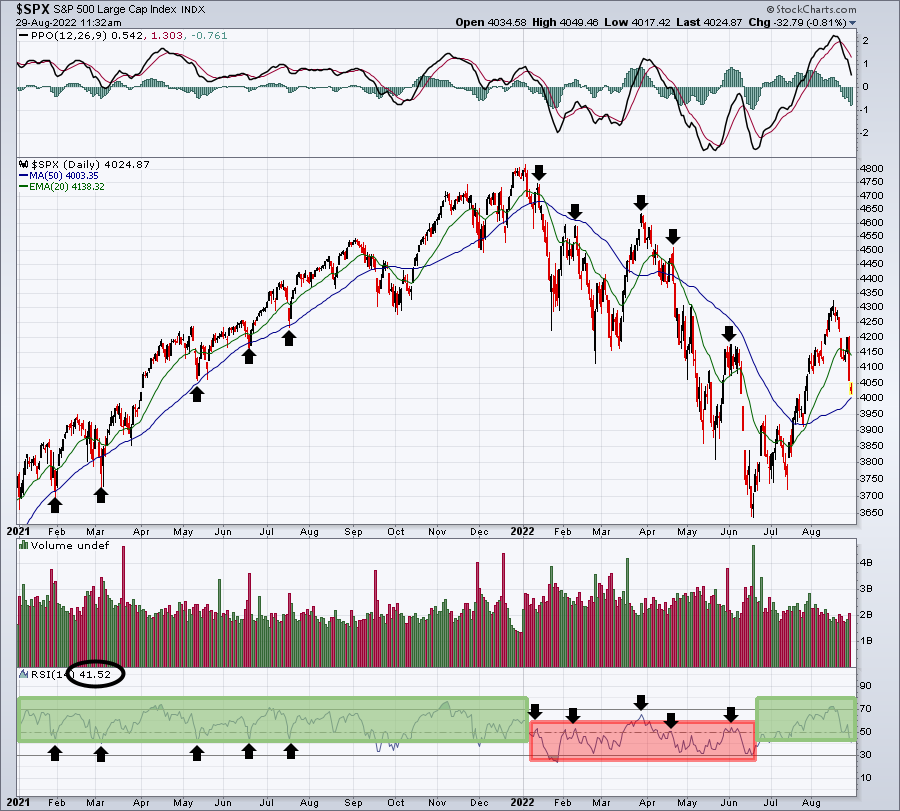
During TRENDLESS periods, we could see the RSI move between 30 and 70. But during uptrends, the RSI range is usually 40-50 on pullbacks to 70+ on advances. During downtrends this RSI range typically is 50-60 to the upside during recoveries and then can move to 30 or lower during selloffs. Here's the 2022 S&P 500 cyclical bear market to help illustrate this concept:
Enter S&P 500 ($SPX):
Let me say that the RSI is just one more signal that can be used. I wouldn't necessarily use it to place buy or sell orders. It's just another piece of evidence, from which to make a better investing decision. It should be used in connection with many other signals and overall market evaluation.
But one thing I want to point out on this chart is that if I'm correct about a mid-June market bottom and the current resumption of the secular bull market, then we should see RSI turn at 40 (or possibly just slightly below). It would be very unusual for the RSI to drop back to 30 or lower and still be in a bull market advance. As you can see from the chart above, RSI remains just above 40. If we see a major reversal over the next 1-3 days, it could occur with a significant RSI (and possibly market) bottom.
 |
Happy Trading!Tom BowleyChief Market StrategistEarningsBeats.comBetter Timing. Better Trades. |