

Understanding The Head & Shoulders Pattern... And Measurement
The beauty of most patterns is that they can be used to determine "measurements" or target prices.
These measurements can be to the upside or the downside. For today, let's discuss the downside target for Tesla, Inc. (TSLA) after this cult stock broke its neckline in October to trigger one of the most shocking declines of 2022. The first important note is that topping head & shoulders patterns ALWAYS follow an uptrend. If you don't have a prior uptrend, then it's not likely you have a head & shoulders pattern. On this TSLA chart, it all begins with the huge advance that TSLA made post-pandemic, from the March 2020 low:
Enter Tesla Inc. (TSLA):
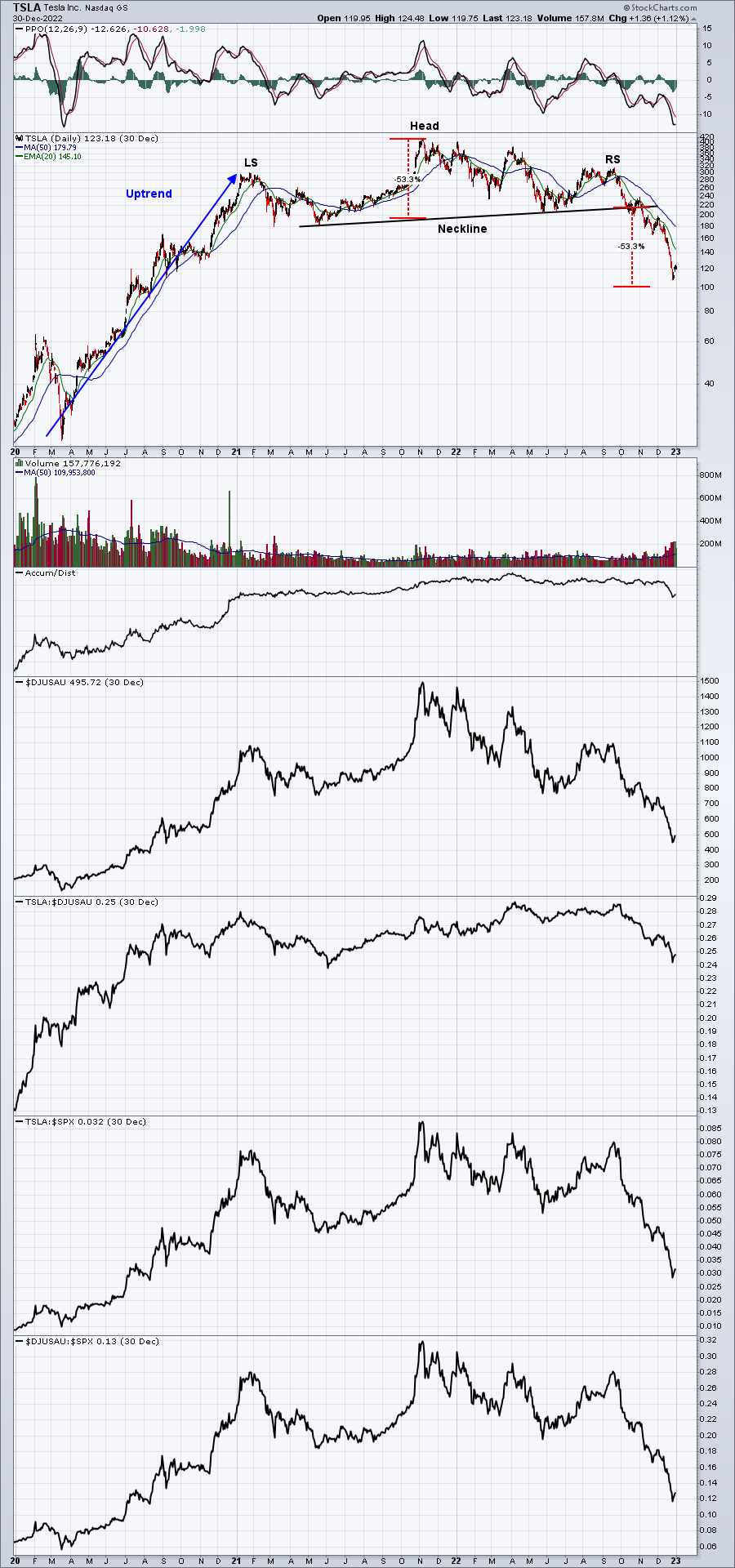
Many will calculate measurements using dollars, rather than percentages. TSLA is a perfect example of why you shouldn't use dollars. At the very top, TSLA traded at 414.50. The neckline directly below that high was approximately 195.00. The dollar difference was 219.50. The breakdown occurred just beneath 220. If we subtract the measurement of 219.50 from the breakdown level, we get zero. Perhaps some of you believe TSLA is going to zero, but I do not. Instead, I calculate this measurement in percentage terms, which is just over 53% from the head to the neckline. Then, from the breakdown level, we subtract another 53% and we achieve a potential downside target of 100.00 or so. A little more than two months later, TSLA hits 108.24. Is that it? Is the free fall over? Well, in the short-term, it appears to be. It's certainly possible that we see a bounce up to or near the rapidly-declining 20-day EMA. But I would not rule out another move lower to possibly hit that 100.00 target. In that process, it could even print a positive divergence on its daily PPO (higher PPO with lower price). That remains to be seen. But the point here is to identify patterns and calculate their potential target to improve your trading success.
 |
Happy Trading!Tom BowleyChief Market StrategistEarningsBeats.comBetter Timing. Better Trades. |