

When It Makes Sense To Ignore A Negative Divergence
When price action moves higher, but momentum oscillators don't follow suit, it's referred to as a negative divergence.
It's a signal that momentum is slowing or stalling and that we should consider a potential top in price. While the textbook definition is very easy to interpret on the surface, we also need to make sure we use a healthy dose of common sense. After all, if a stock breaks out to a new high on massive volume, but a momentum oscillator lags, is it really a sign of slowing momentum? On Tuesday, Apple (AAPL) soared on AI news, closing at an all-time high above 200.00 and producing one of its highest volume days since the 2020 pandemic:
Enter Apple, Inc. (AAPL):
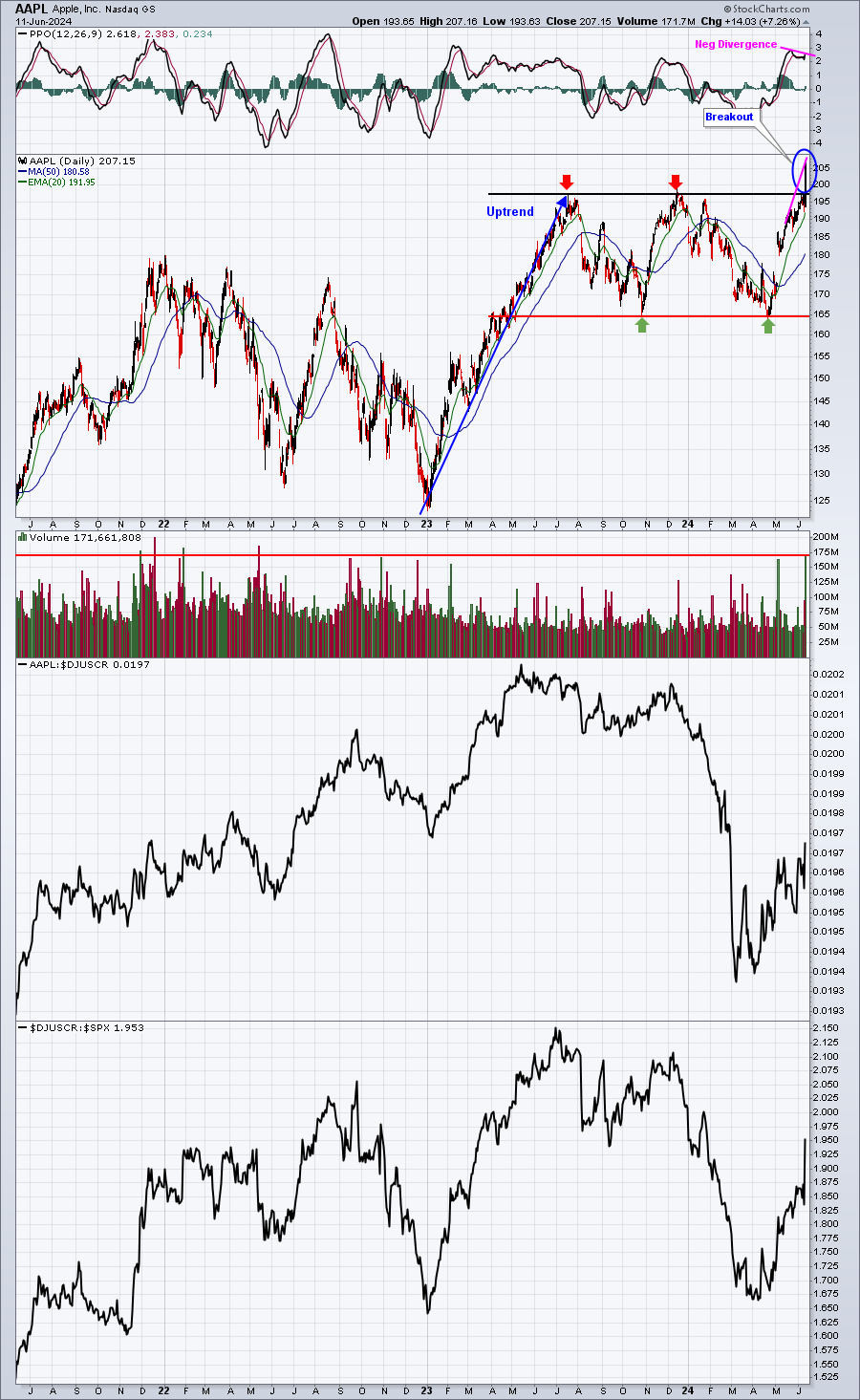
Price and volume is our PRIMARY indicator. Negative divergences are SECONDARY indicators. If I see a very heavy volume price breakout, I am not going to look at a negative divergence and think, "slowing momentum". AAPL's breakout on Tuesday was accompanied by volume that's been topped just 4 times in the past 3 years. If anything, I'd say momentum was incredibly strong on the price breakout, not weakening. Sometimes, we get so caught up in the technical analysis "rules", that we forget to use plain old common sense. Over the next few days, I believe you'll see the negative divergence completely disappear on AAPL. That's why many technicians never recognize failed divergence signals, because most are eliminated by a resuming uptrend. Out of sight, out of mind.
 |
Happy Trading!Tom BowleyChief Market StrategistEarningsBeats.comBetter Timing. Better Trades. |