
EB Weekly Portfolio Report - Sunday, January 26, 2020
Upcoming Earnings Reports (New Feature)
The following companies will be reporting earnings this week and they're a component of one of our portfolios:
Monday, January 27: None
Tuesday, January 28: AAPL
Wednesday, January 29: MSFT
Thursday, January 30: AMGN, RTN, VRTX, MSCI, DOV, MUR
Friday, January 31: None
PLEASE NOTE: The above companies were provided after scanning the Zacks Earnings Calendar. My research is limited to what Zacks provides and I also can make a mistake from time to time, so please check for earnings dates for all companies that you own. We do hold our portfolio stocks through one earnings report, but every EarningsBeats.com member must make their own investing/trading decisions about holding stocks into earnings reports as it's the most volatile (risky) time to own a stock.
Portfolio Rules and Objectives
Here are the common traits and objectives of each portfolio:
- There are 10 leading stocks from 10 leading industries in each portfolio (at the time of selection)
- They are held for an entire 90 day period, with generally no stops in place (KMX and UTHR were exceptions)
- Every stock will generally be held through ONE earnings report
- The expectation is that relative winners will carry the portfolio to outperformance
- They are all entered into as of February 19, May 19, August 19, and November 19 (these dates are used as we are generally past the majority of earnings reports by these dates)
- Primary objective is to outperform the benchmark S&P 500
Here are several considerations for EB members:
- I would expect the CC (Character Change, formerly Value portfolio) and Aggressive portfolios to be the riskiest, followed by the Model portfolio, and then the Income portfolio
- The CC portfolio is a new breed and is much different from the others; it's quite diversified, but how it ranks in volatility among the four remains to be seen - I would anticipate high volatility and that's certainly what we've seen in its first two months.
- The Income portfolio stocks will all pay dividends, with the expected average dividend yield to be at least 1.5%
- Drawdowns (losses) should be much milder on the Income portfolio, with more volatility expected on the other three; please review inception-to-date charts to gain an idea of volatility associated with each
- You should own or trade these stocks in whatever manner is most comfortable for you; while we buy all 10 stocks as of the dates identified above, feel free to trade certain stocks or wait for pullbacks if the stocks are overbought
- We have no idea what risk each member is willing or able to take. We are not registered investment advisors so be sure you understand the risk you take. Please consult your financial advisor.
- EarningsBeats.com shareholders/employees may own all or some of the portfolio stocks from time to time.
Snapshot
Here's a weekly recap:
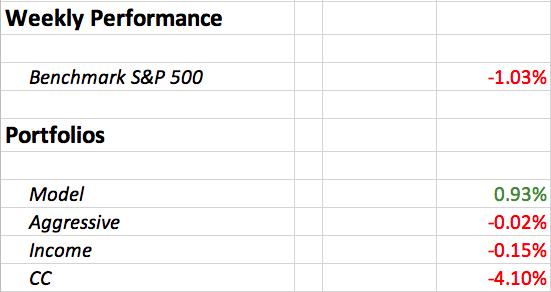
The Model, Aggressive, and Income portfolios all performed well on a relative basis last week, but it was a very difficult week for several stocks in the CC portfolio (formerly Value portfolio). Thanks to everyone who responded with possible name changes for this portfolio. At the end of the day, I felt "character change", or CC, was the best description of the stocks included in this portfolio.
Weekly Summary
Benchmark S&P 500:
The S&P 500 ran into a lot of sellers on Friday as that benchmark index fell 1.03% on the week. I've provided short-term warnings of late, but buyers remained mostly in control of the action.....until Friday. Money has turned very defensive over the past couple weeks. The 10 year treasury yield ($TNX), which moves inversely to treasury prices, saw a huge tumble last week, the second such drop in the last 4 weeks:
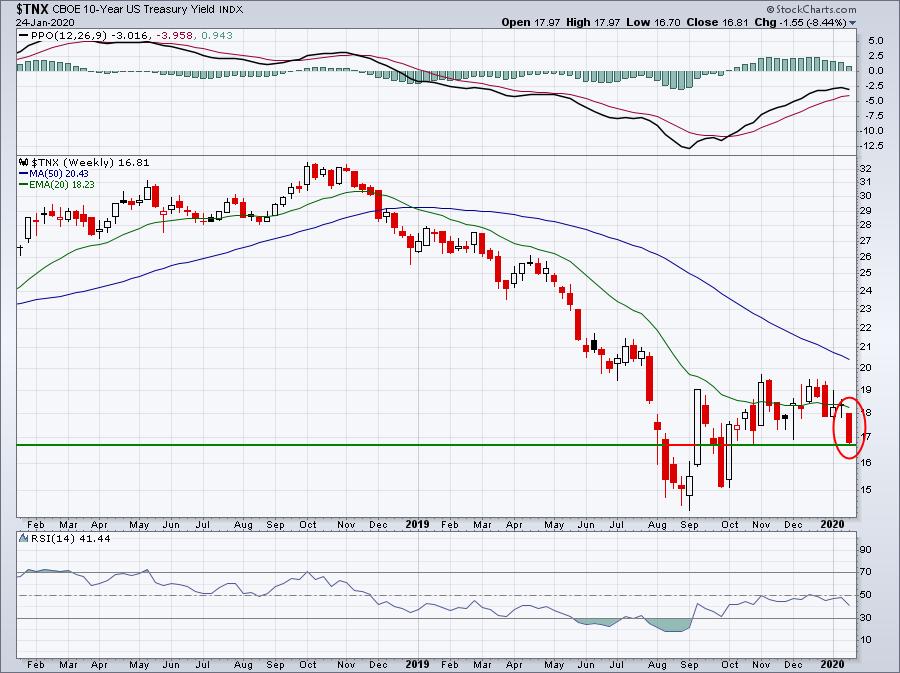
Every dollar that goes into bonds is a dollar that doesn't go into stocks. The biggest stock market rallies typically accompany rises in the 10 year treasury yield. A falling yield in a bear market is usually the kiss of death for equities. In a bull market, however, it's typically a signal for hesitation, or consolidation, in equities. That's what I'm expecting now. If we need another confirming signal of cautiousness, well Wall Street's been giving us that:
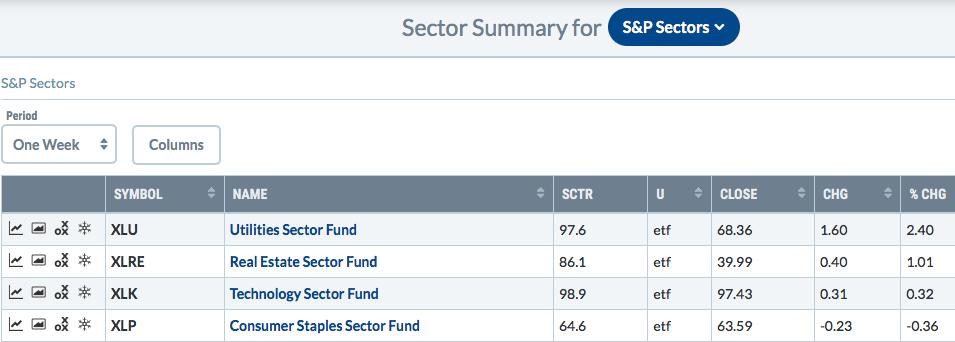
That's sector performance last week. Three defensive sectors in the top four. I don't know that we'll see a big selloff, but Wall Street definitely is more prepared for it, if it were to occur.
Model Portfolio:
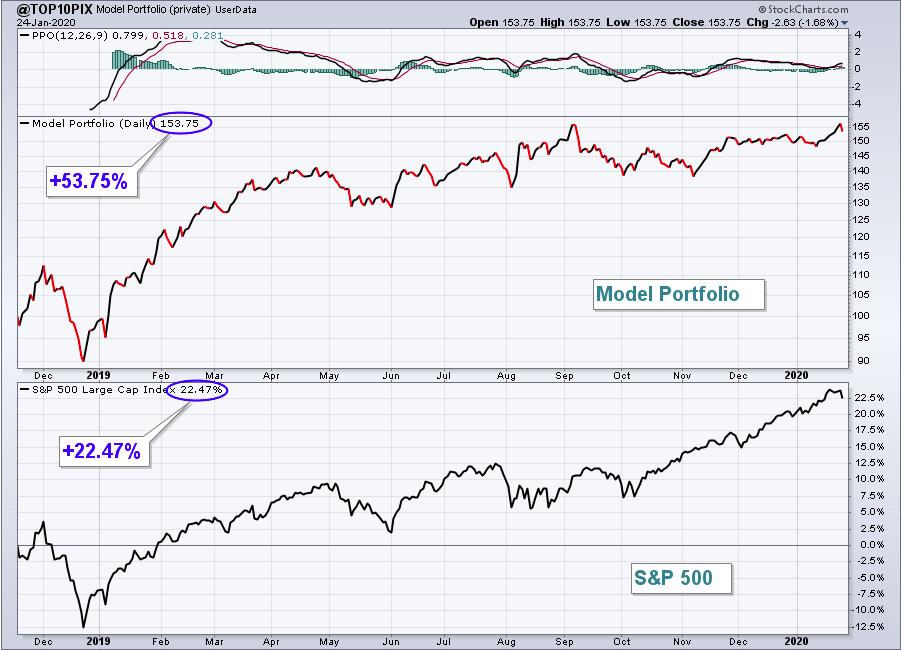
The Model portfolio had a very solid week, gaining 0.93% for the week. Here's the updated inception-to-date chart of the portfolio:
Here are how the Model portfolio component stocks performed last week:
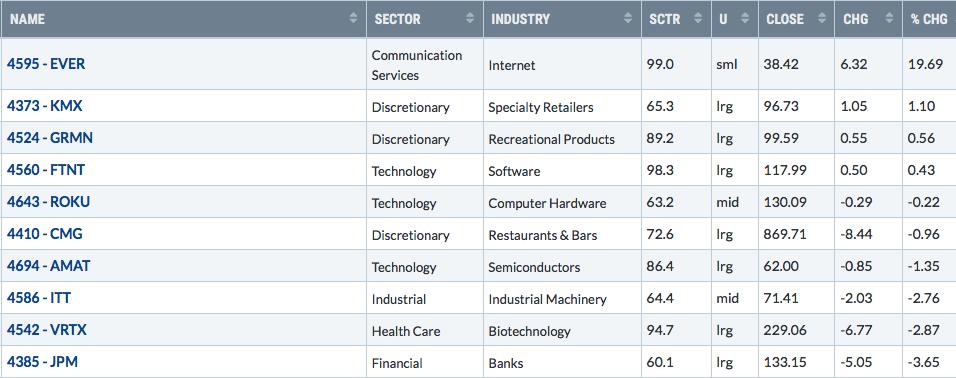
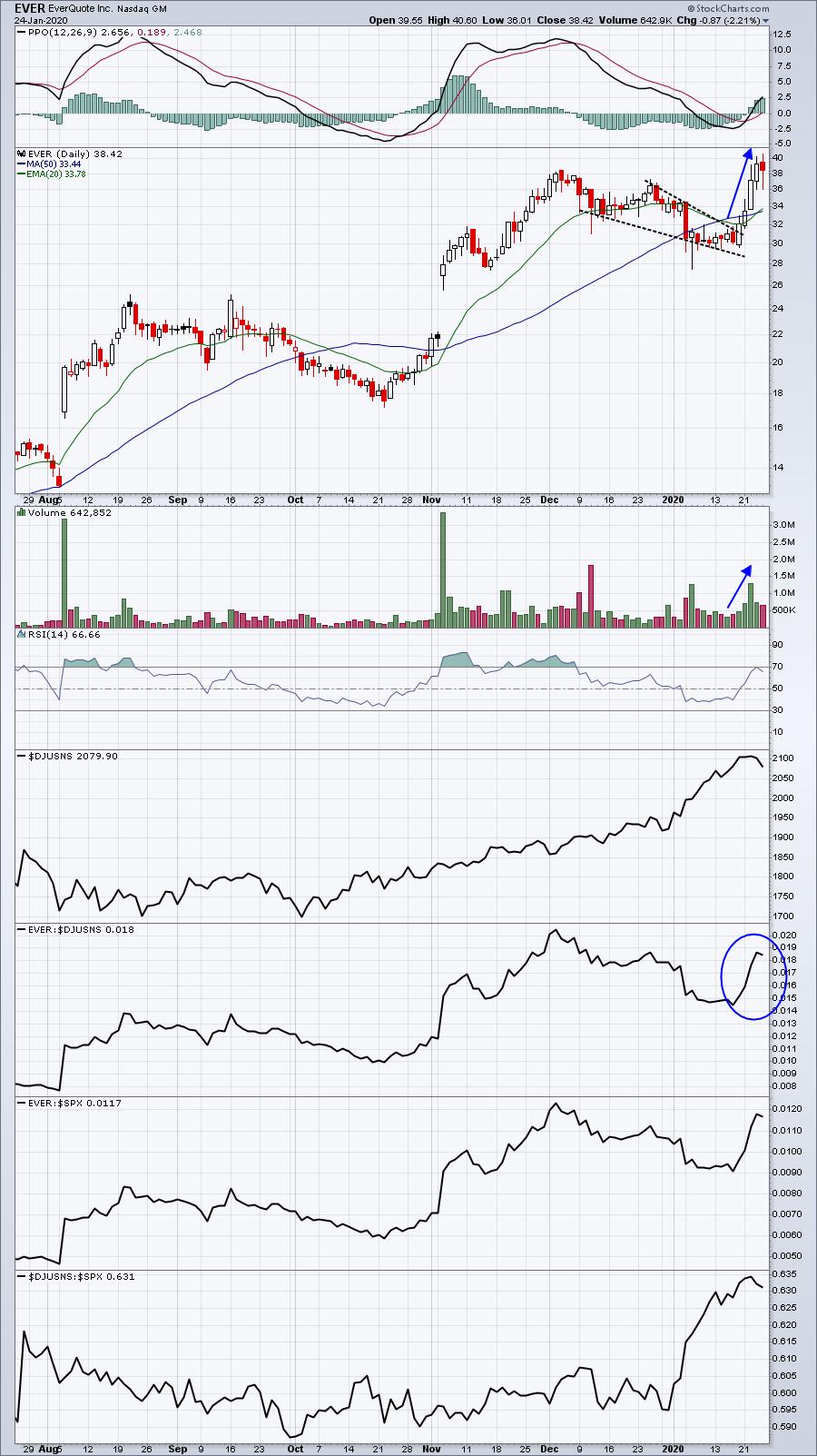
EVER was clearly the big winner and the reason for the Model portfolio's outperformance. It's also the only small cap stock in the portfolio, even more impressive considering the lack of strength in small cap stocks. I had mentioned in a Daily Market Report earlier this week that EVER appeared to be beginning a pre-earnings advance. I'm looking for strong results when EVER reports, especially given last week's breakout:
JPM was the Model portfolio's worst performer, but it's no wonder. The big drop in the TNX usually results in pressure for bank stocks ($DJUSBK). Here was last week's industry leaders/laggards within the financial sector (XLF):
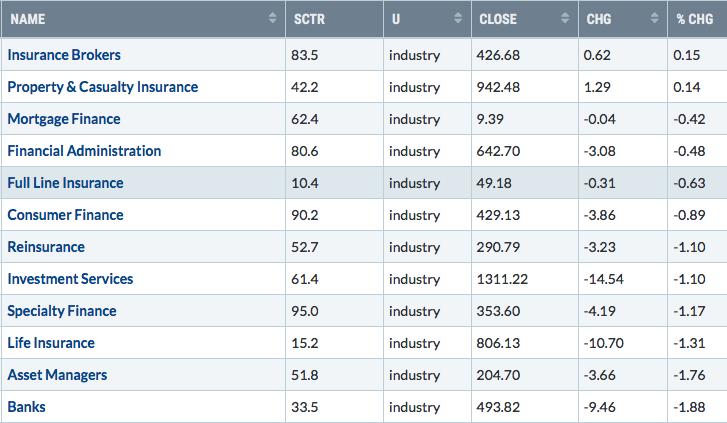
Banks were dead last.
Aggressive Portfolio:
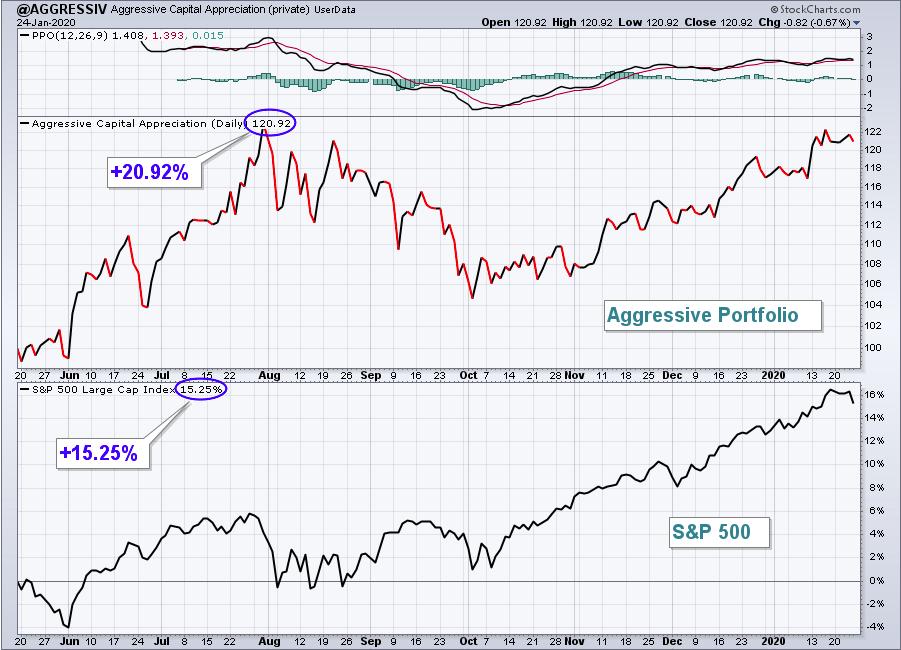
The Aggressive portfolio had another solid week last week, dropping just 0.02%. Here's the Aggressive portfolio chart since its inception on May 19, 2019:
Here are how the Aggressive portfolio component stocks performed last week:
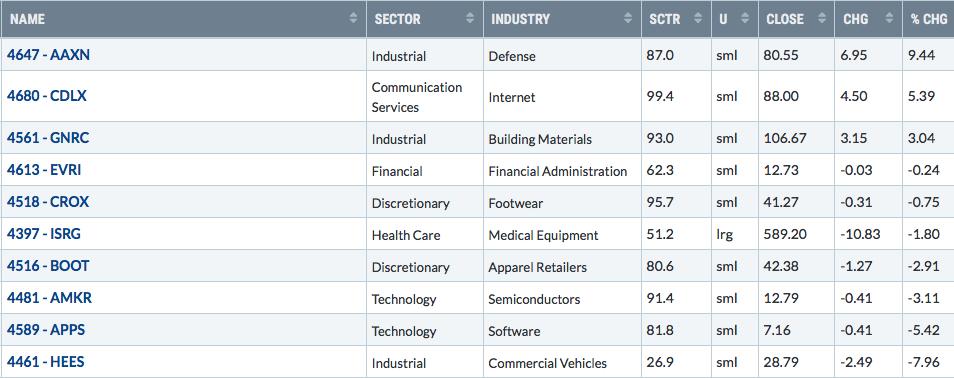
Despite a poor week for U.S. equities, and an even poorer week for small caps ($SML, -2.24%), the Aggressive portfolio managed to hold up well and easily outperform the benchmark S&P 500. AAXN, a defense stock, gained nearly 10% and broke out last week:
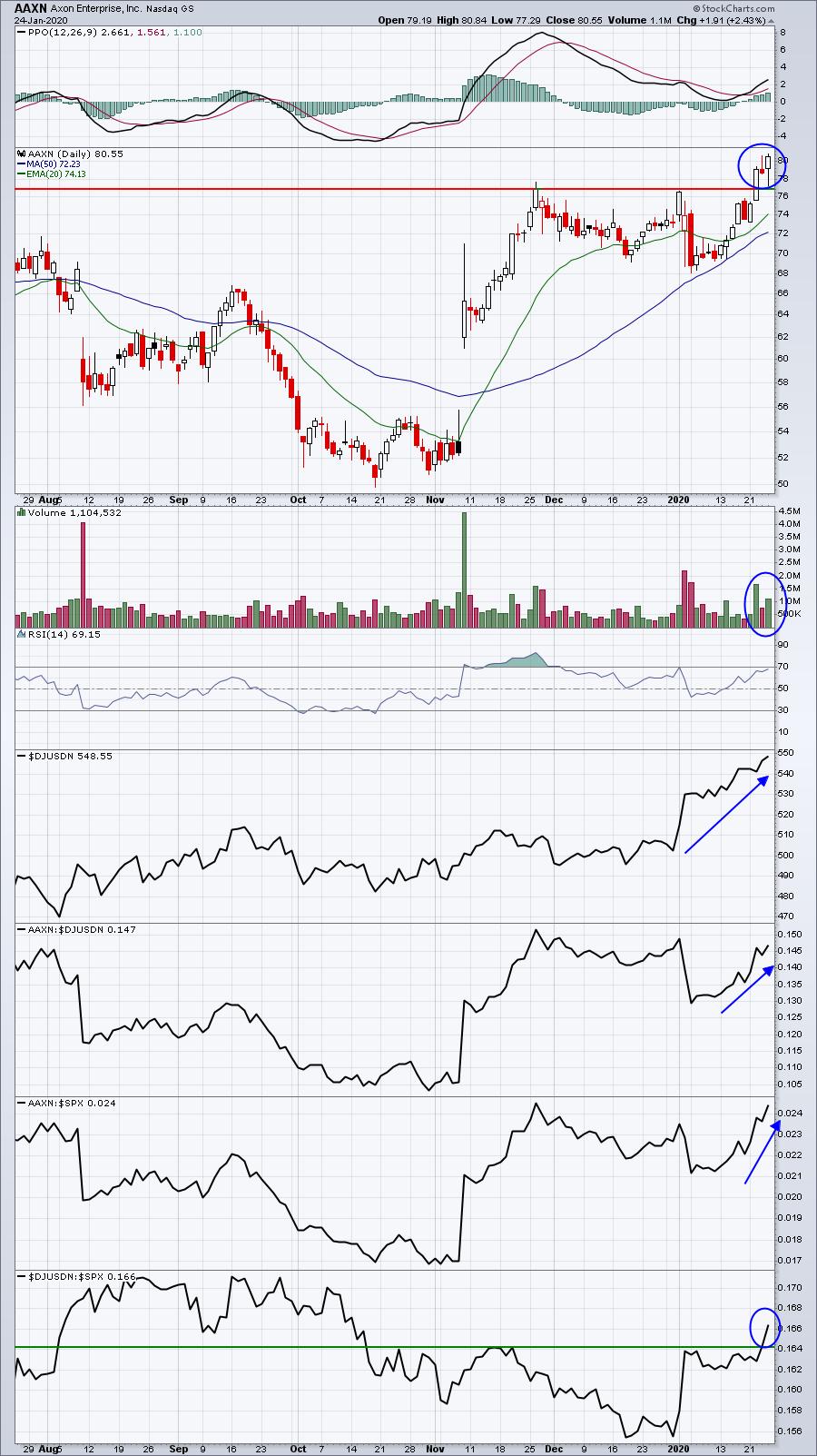
Really worth noting is the bottom panel of this chart, which shows defense stocks ($DJUSDN) breaking to a 3 month relative high vs. the S&P 500. This industry group is definitely seeing more than its fair share of money to begin 2020 and could be one of the leading industry groups for the entire year. Right now, we want exposure to this group.
HEES has really held back this portfolio, but its chart is somewhat perplexing. There's most definitely a downtrend now in place, but its industry group, commercial vehicles & trucks ($DJUSHV), hasn't broken below key support (green-shaded zone). Yet every other signal tells us that HEES is downtrending:
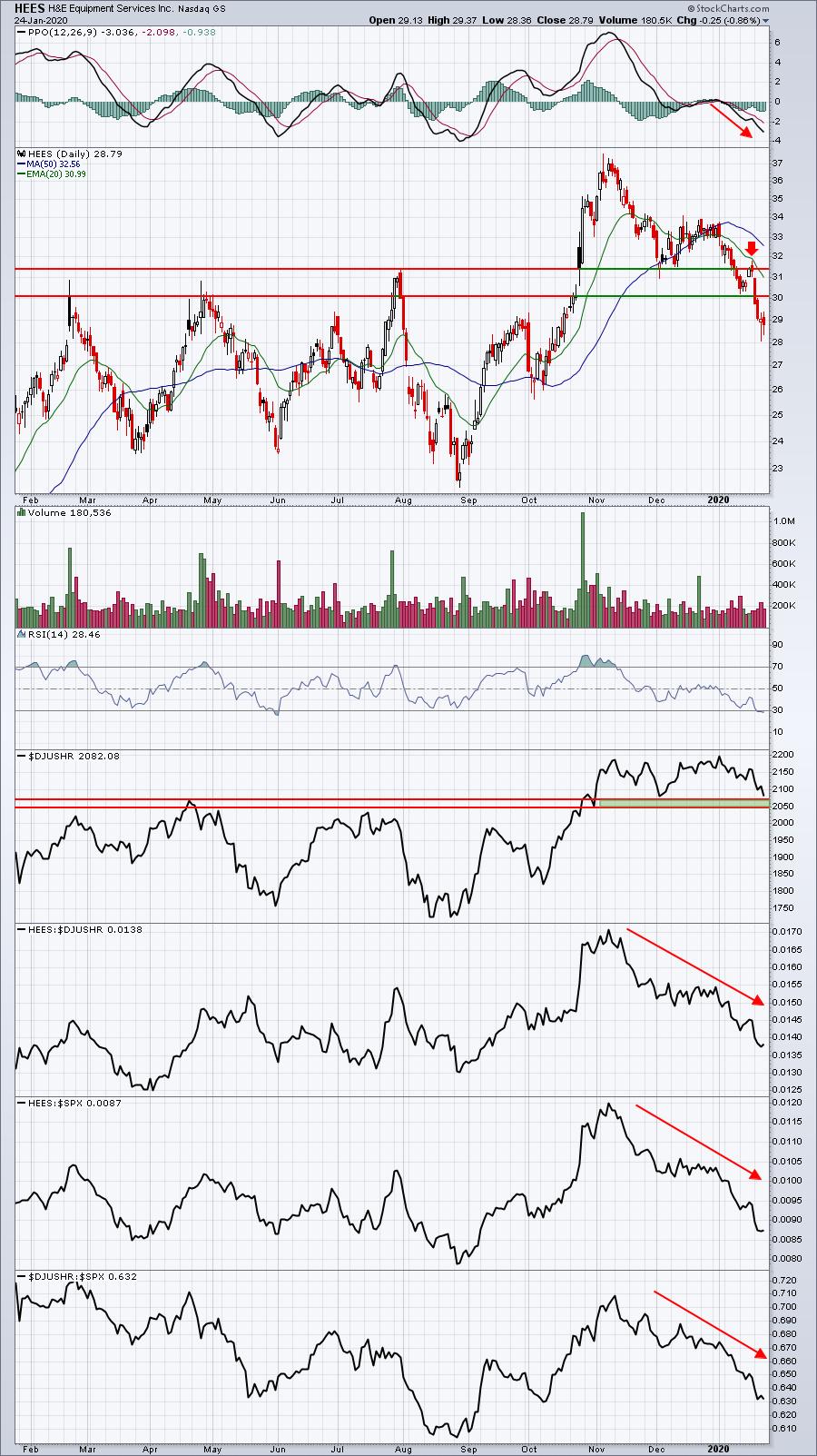
Relative strength lines above look quite bearish, HEES failed to hold its final gap support near 30 and the 20 day EMA failure (red arrow) is also indicative of a falling stock. Volume hasn't been huge on this selling, however, so I'm clinging to the hope that the DJUSHV holds onto the price support zone highlighted. We'll see.
Income Portfolio:
The Income portfolio outperformed the S&P 500 last week, but did still give back 0.15%. Here's a look at the inception-to-date chart:
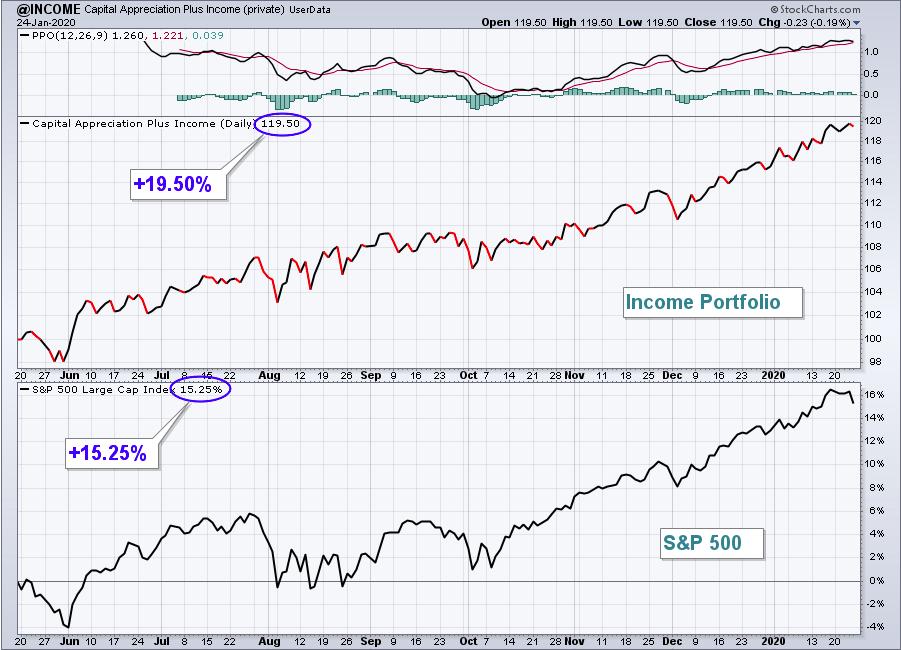
Here are how the Income portfolio component stocks performed last week:
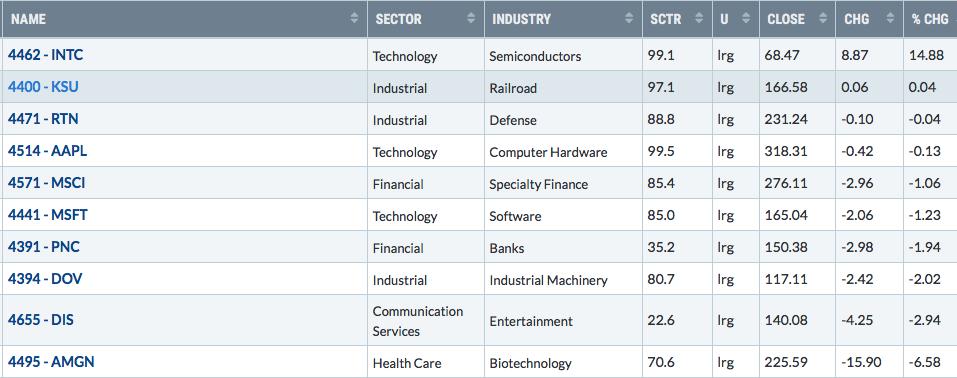
Traders loved the INTC earnings report that was released on Thursday after the bell. That, quite honestly, held up the Income portfolio, which otherwise would have likely lagged the benchmark. INTC broke out, though, and certainly looks poised for further gains ahead:
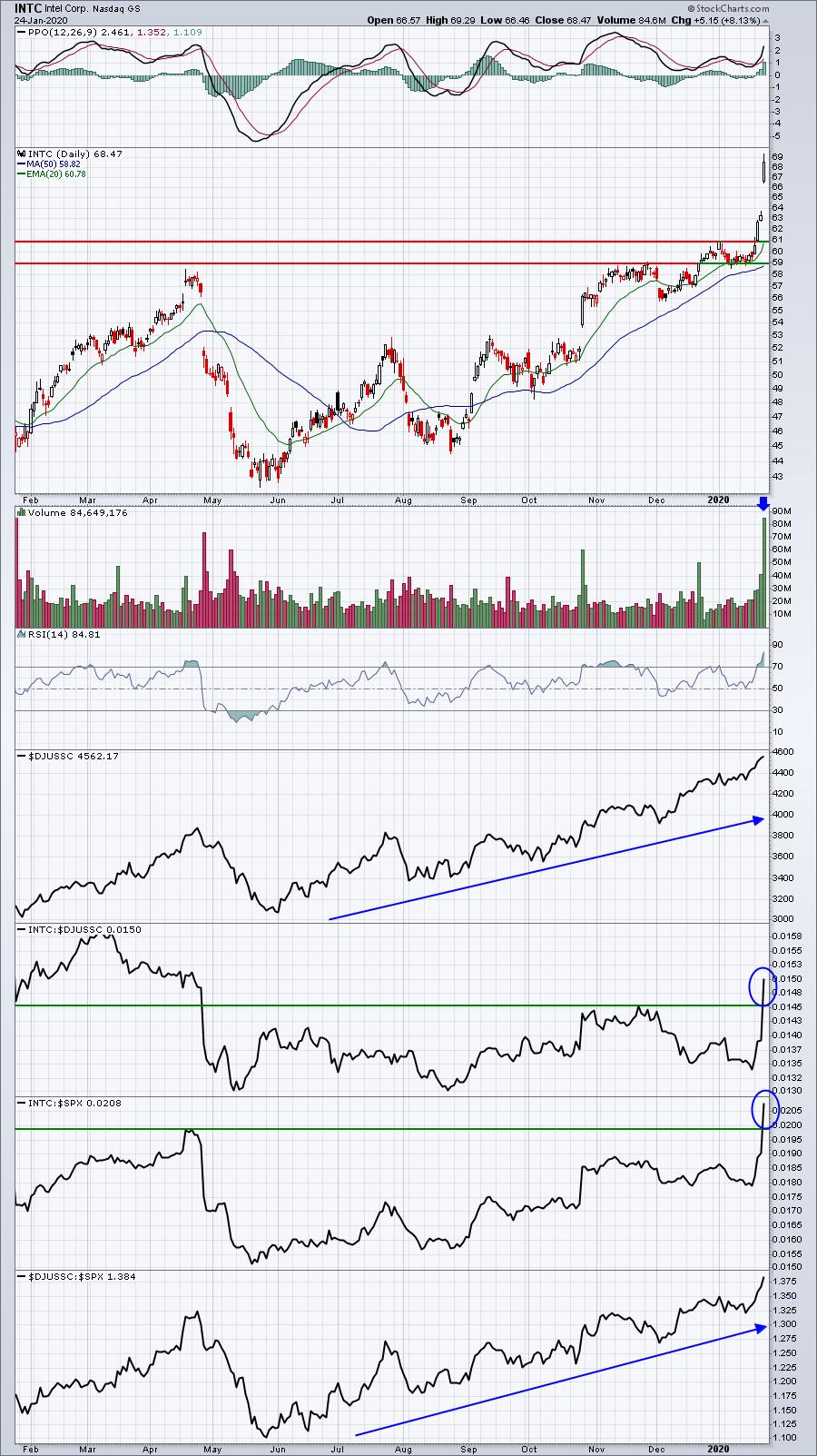
Volume soared on Friday, suggesting that Wall Street took notice and was accumulating shares. INTC will likely be part of a portfolio next quarter as well.
Character Change (CC, formerly Value) Portfolio:
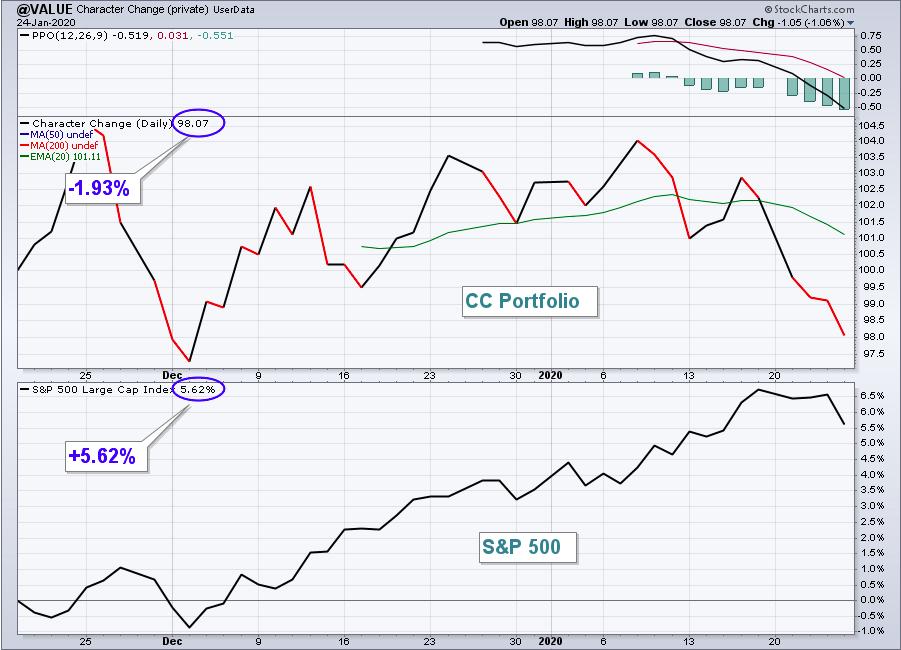
The CC portfolio experienced a very rough week, losing 4.10%. Here is the inception-to-date chart since November 19, 2019:
Here are how the CC portfolio component stocks performed last week:
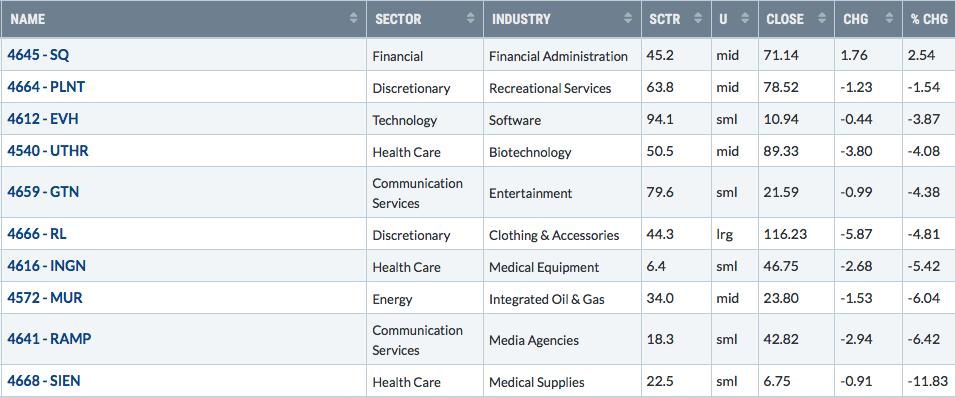
Ugliness. That's what I see above. 9 of 10 component stocks were lower last week and all 9 underperformed the S&P 500. As I mentioned last week, I'm not interested in eliminating this portfolio type just yet, but I'm going to want to see much better performance over the balance of 2020. I like the strategy, but thus far too many stocks are failing to sustain their initial rallies.
Summary
Over the past couple weeks, our 3 oldest portfolios - Model, Aggressive, and Income - have performed extremely well relative to the benchmark S&P 500. The former (Model) has gained roughly 3.5% over the last two weeks, easily outpacing the S&P 500's gain of just under 1.0%.
I'm considering three changes for next quarter:
(1) No stops. The idea initially for these portfolios was that they'd provide an alternative to trading. We simply add 10 stocks from 10 different industry groups and we hold them until the end of the three month period. The problem I'm having with the stops is that stocks where we used stops have rebounded and the stocks where we haven't had stops have continued to fall. This is the type of dilemma traders face and the whole idea of these portfolios is for them to be different from an active trading strategy and EASY.
(2) Include the same stock in multiple portfolios. We now have four portfolios and one problem is that stocks that I really like are only in one portfolio, even though they're "qualified" to be in more than one. For instance, AAPL was the best performing stock in the best performing industry group heading into last quarter. It was included in the Income portfolio because it paid a nice dividend, but it was easily one of my ten favorite stocks and also belonged in the Model portfolio. ROKU, a computer hardware stock, would likely have been moved to the Aggressive portfolio.
(3) Enter portfolio positions at multiple price levels, rather than just buying at the close on February 19, May 19, August 19, November 19. This could be a strategy that really helps performance and it makes much more sense now that we have commission-free trading. The idea would be to buy stocks in increments during a period of the calendar month (19th to 25th) when the stock market typically falls. Using this strategy, I believe our cost basis of many portfolio stocks will be lower and returns ultimately bolstered. Whatever is not bought by the 25th would be added as of the 25th closing price.
Let me know your thoughts. You can send me an email at "[email protected]".
Happy trading!
Tom Bowley, Chief Market Strategist
EarningsBeats.com
"Better timing. Better trades."