
EB Weekly Portfolio Report - Sunday, March 1, 2020
Upcoming Earnings Report
The following companies will be reporting earnings this week and each is a component of one of our portfolios:
Monday, March 2: None
Tuesday, March 3: CDLX
Wednesday, March 4: None
Thursday, March 5: None
Friday, March 6: None
PLEASE NOTE: The above companies were provided after scanning the Zacks Earnings Calendar. My research is limited to what Zacks provides and I also can make a mistake from time to time, so please check for earnings dates for all companies that you own. We do hold our portfolio stocks through one earnings report, but every EarningsBeats.com member must make their own investing/trading decisions about holding stocks into earnings reports as it's the most volatile (risky) time to own a stock.
Portfolio Rules and Objectives
Here are the common traits and objectives of each portfolio, some of these were just changed for our February 19th "draft" day last week (changes for the upcoming quarter are in bold italics):
- There are 10 leading stocks from up to 10 leading industries in each portfolio (at the time of selection) - the change here is to allow a second stock within the same industry group
- They are held for an entire 90 day period, with no stops in place - there will be NO stops. All stocks will be held for the entire period (members may choose to have stops, but we will not)
- Every stock will generally be held through ONE earnings report
- The expectation is that relative winners will carry the portfolio to outperformance
- They were all entered into as of close on February 19th
- We decided against having multiple entries for our purposes, but members were encouraged to enter based on whatever felt most comfortable
- Primary objective is to outperform the benchmark S&P 500
Here are several considerations for EB members:
- I would expect the CC (Character Change, formerly Value portfolio) and Aggressive portfolios to be the riskiest, followed by the Model portfolio, and then the Income portfolio
- The CC portfolio's strategy and composition was changed a bit in it second quarter, as we decided to include companies that have broken out of a consolidation range, not just those with breakaway gaps to end a downtrend
- The Income portfolio stocks will all pay dividends, with the expected average dividend yield to be at least 1.5%
- Drawdowns (losses) should be much milder on the Income portfolio, with more volatility expected on the other three; please review inception-to-date charts below to gain an idea of the volatility associated with each
- You should own or trade these stocks in whatever manner is most comfortable for you; while we will buy all 10 stocks in the manner identified above, feel free to trade certain stocks or wait for pullbacks if the stocks are overbought
- We have no idea what risk each member is willing or able to take. We are not registered investment advisors so be sure you understand the risk you take. Please consult your financial advisor.
- EarningsBeats.com shareholders/employees may own all or some of the portfolio stocks from time to time.
Snapshot
Here's a weekly recap:
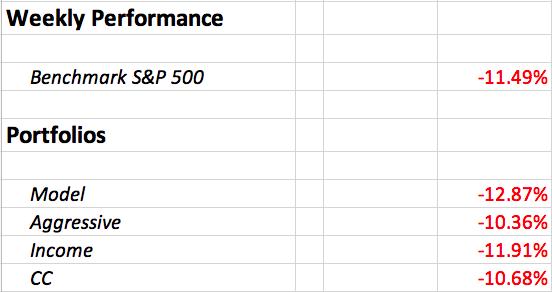
The Aggressive and CC portfolios outperformed the benchmark S&P 500, while both the Model and Income portfolios trailed that benchmark.
Weekly Summary
Benchmark S&P 500:
The S&P 500 had its worst week since the financial crisis in early-October 2008, tumbling 11.49% on the week. The losses cleared key price support at 3025 and now opens up the possibility of a test of price support close to 2720. That would represent a 20% drop and technically a cyclical bear market. Here's the visual:
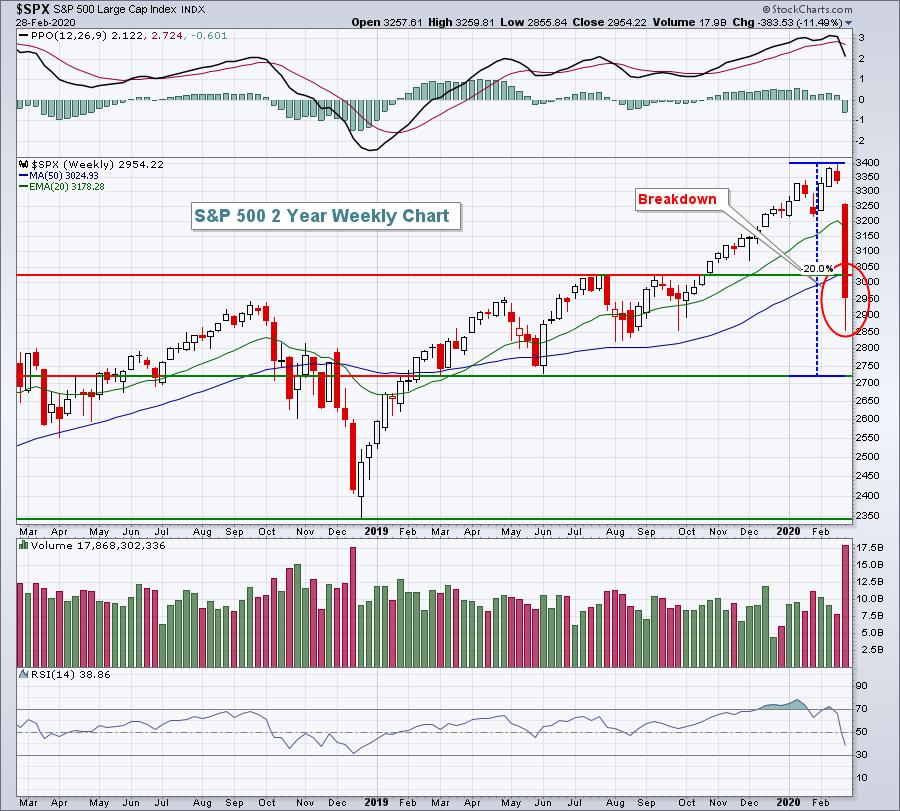
There's no getting around it. It was a brutal week. I stated in last week's report that I wouldn't be surprised to see more downside early in the week as we were in that 19th to 25th period of the calendar month where the market tends to underperform. Also, the prior week was options expiration and we saw selling to close out that week. A follow through of that selling certainly would not have been a surprise.
But.......I never saw the massive selling that hit as a result of coronavirus fears. The Volatility Index ($VIX) shot up early in the week and, from a short-term trading perspective, that's kryptonite for me. But when I discuss our portfolios, I'm thinking with a longer-term strategy in mind. I fielded a few questions from members this week, asking why I wasn't discussing strategy with portfolio stocks throughout the week. You must remember, these portfolios are bought and held for three months. Then we find new stocks to fill out the portfolios and we buy and hold for three months. They are not short-term trading portfolios and shouldn't be viewed as such. If you want to short-term trade, then I'd encourage you to follow my Daily Market Report (DMR), where I provide my short-term view of the market every day.
For example, on Monday, I wrote the following in the Market Outlook section:
"One thing to watch for is a reversal back to the upside on heavy volume. It could happen later today, or it might be a few days. That reversal in the S&P 500 will likely leave a HUGE tail to the upside in the Volatility Index ($VIX). Many times that will mark important bottoms."
On Tuesday, I wrote the following:
"The VIX is gaining steam to the upside and when the VIX is high, we MUST remain on high alert for impulsive bouts of selling that are not rational. How do you prepare for that? Well, from my perspective, I'm a short-term trader. Cash is king and the preservation of cash is extremely important. I don't like making emotional trades. So I've made the decision to cut down the number and size of my trades considerably and I do not plan on being an active trader in the very near-term - at least until the dust settles.
I'd rather miss a reversal and some upside than to hold during a big decline. Honestly, I don't know how anyone, with any precision, can call market movements in periods like this. So I'd rather be on the sidelines, or mostly on the sidelines. I have not changed my bullish stance on the market, nor on the big picture environment, which still includes strong earnings growth, low inflation, lower interest rates ahead, etc. I wouldn't change my strategy if I was a "buy and hold" type investor. I believe this will pass in time. But having a long-term mentality as a short-term trader can prove devastating during very brief periods and I'd rather avoid that possibility."
The purpose of providing you these excerpts is simply to point out the difference between viewing the stock market with a short-term mentality vs. viewing it with a long-term mentality. We hold the portfolios without regard to volatility because those are designed for investors with longer-term horizons. They remain invested 100% of the time, while positions are simply rotated quarterly. My DMR comments highlighted in italics above are for those traders with the short-term environment in mind.
Model Portfolio:
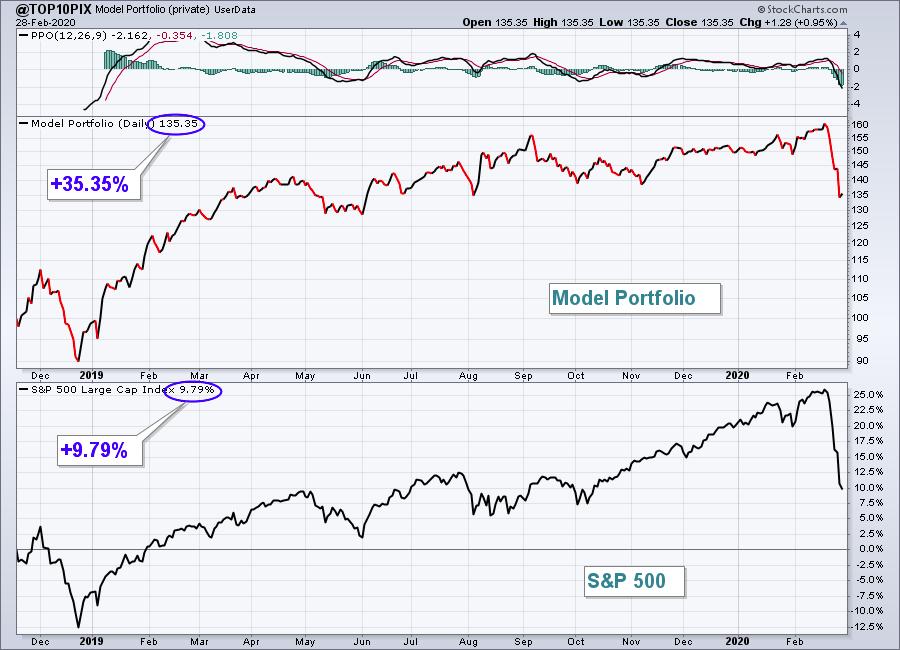
The Model portfolio was crushed with the overall market and slightly underperformed the S&P 500, losing 12.87%. Here's the updated inception-to-date chart of the portfolio:
Here are how the Model portfolio component stocks performed last week:
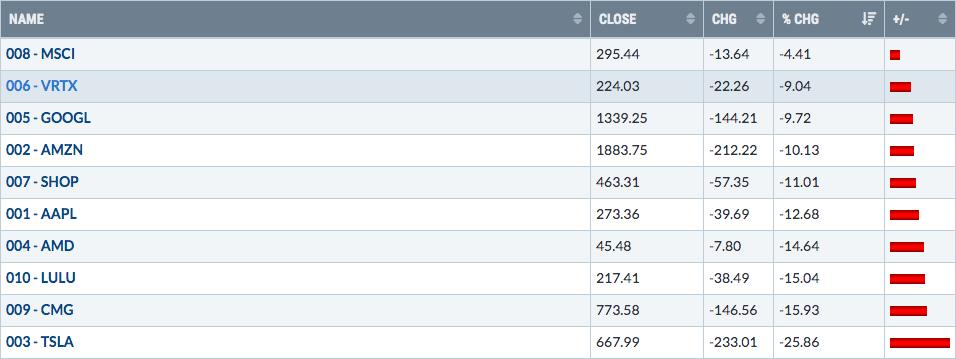
TSLA was the big loser in the portfolio and I guess the case could be made that it had the most to lose given its rapid rise over the past few months:
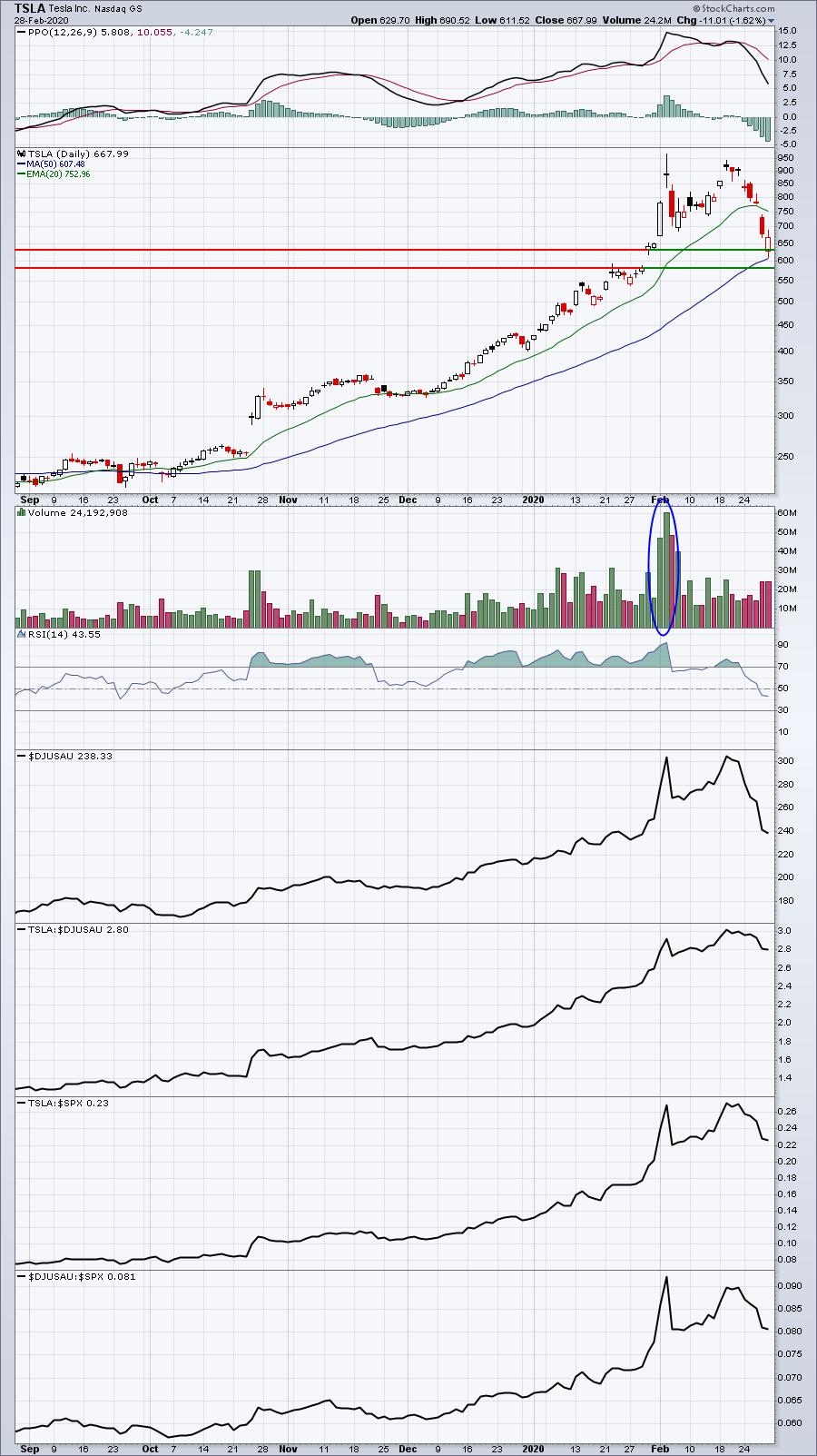
The overall uptrend in both absolute and relative price action remains strong. Any stock that moves higher as fast as TSLA did will typically suffer harder during a downtrend. Gap support is highlighted above with the horizontal support lines. Note the 50 day SMA is in the middle of gap support as well. If this area of support is lost this week, the 20 week EMA is currently at 527 and rising.
Aggressive Portfolio:
The Aggressive portfolio did manage to outperform the S&P 500 last week, which is no small task, but it still lost 10.36%. Here's the Aggressive portfolio chart since its inception on May 19, 2019:
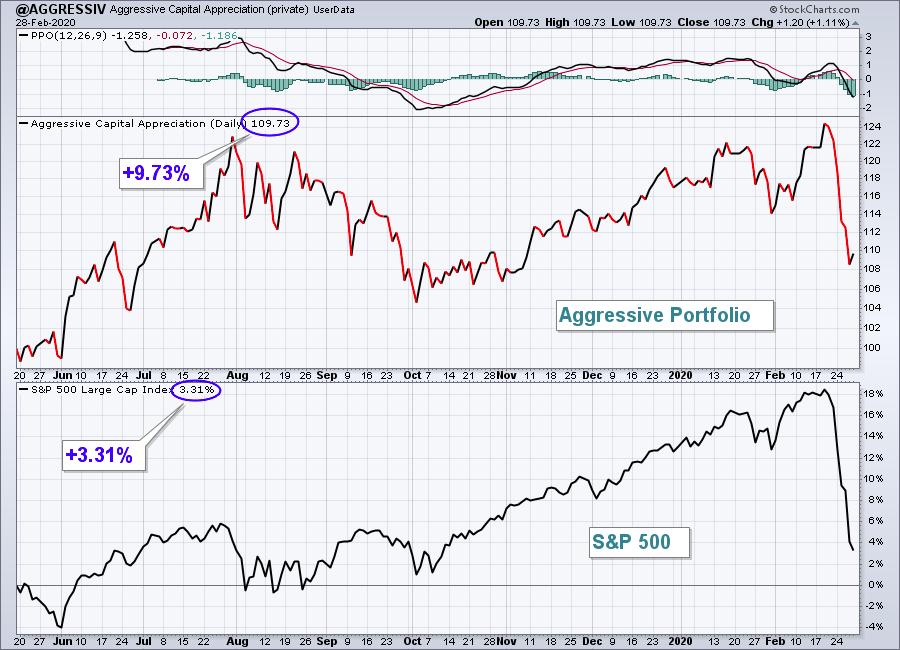
Here are how the Aggressive portfolio component stocks performed last week:
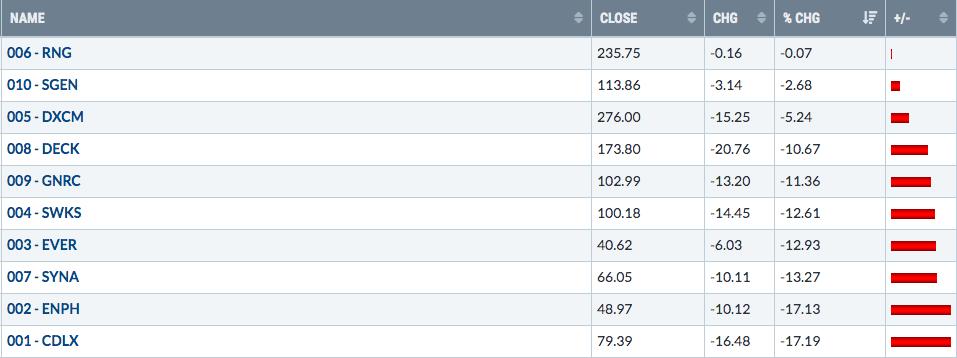
The worst performer, CDLX, reports its latest quarterly results this week. The best performer, RNG, was flat this week. Its chart highlights the huge improvement in relative strength, which was already strong:
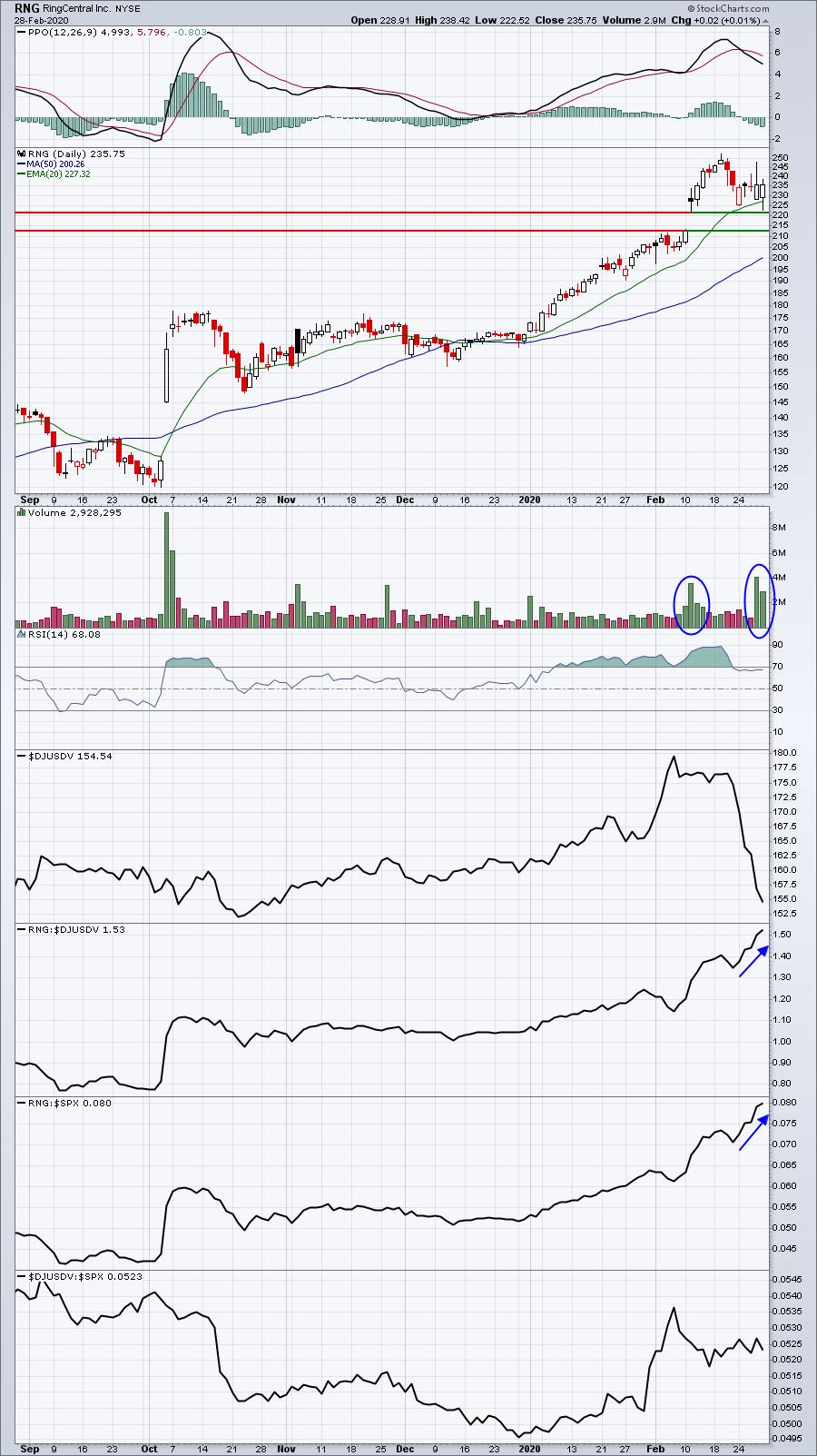
RNG was one of few companies that saw key short-term price support hold. Its relative strength is off the charts, almost literally, so clearly Wall Street loves the company.
Income Portfolio:
The Income portfolio underperformed slightly last week, falling 11.91% . Here's a look at the inception-to-date chart:
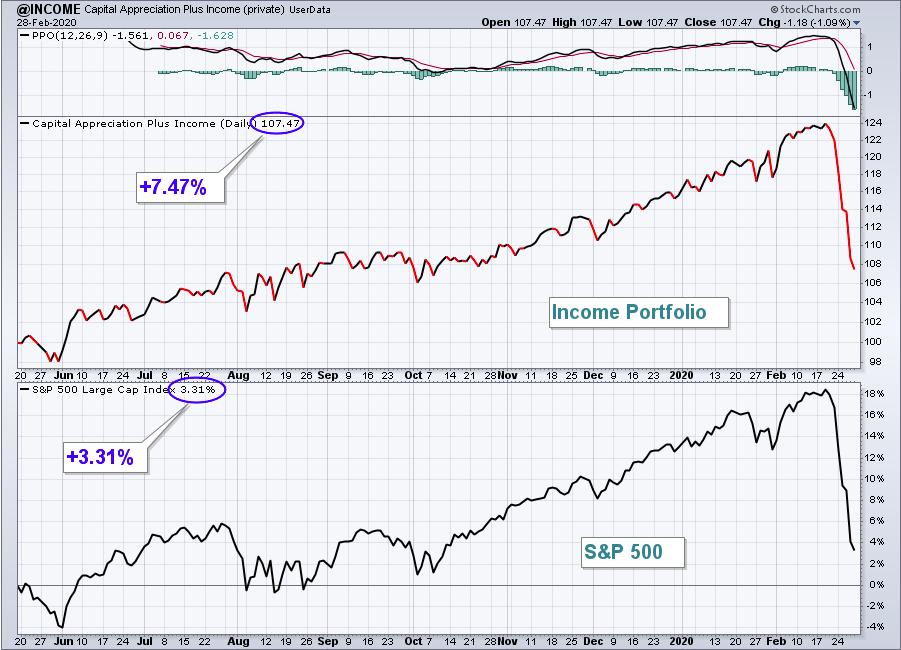
Here are how the Income portfolio component stocks performed last week:
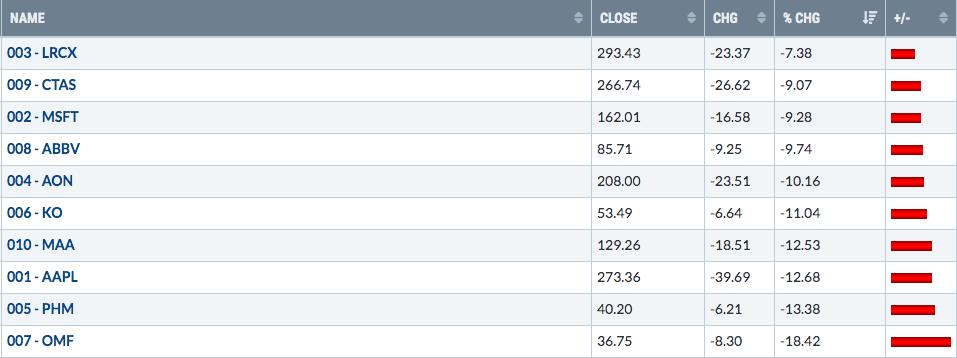
The big reason the Income portfolio lagged a bit was OMF's 18% loss. Its consumer finance ($DJUSSF) peer group had a very rough day on Tuesday, dropping 6% that day alone, and ended up losing more than 14% for the week. OMF underperformed its peers, but I'm still ok with the stock's primary trend:
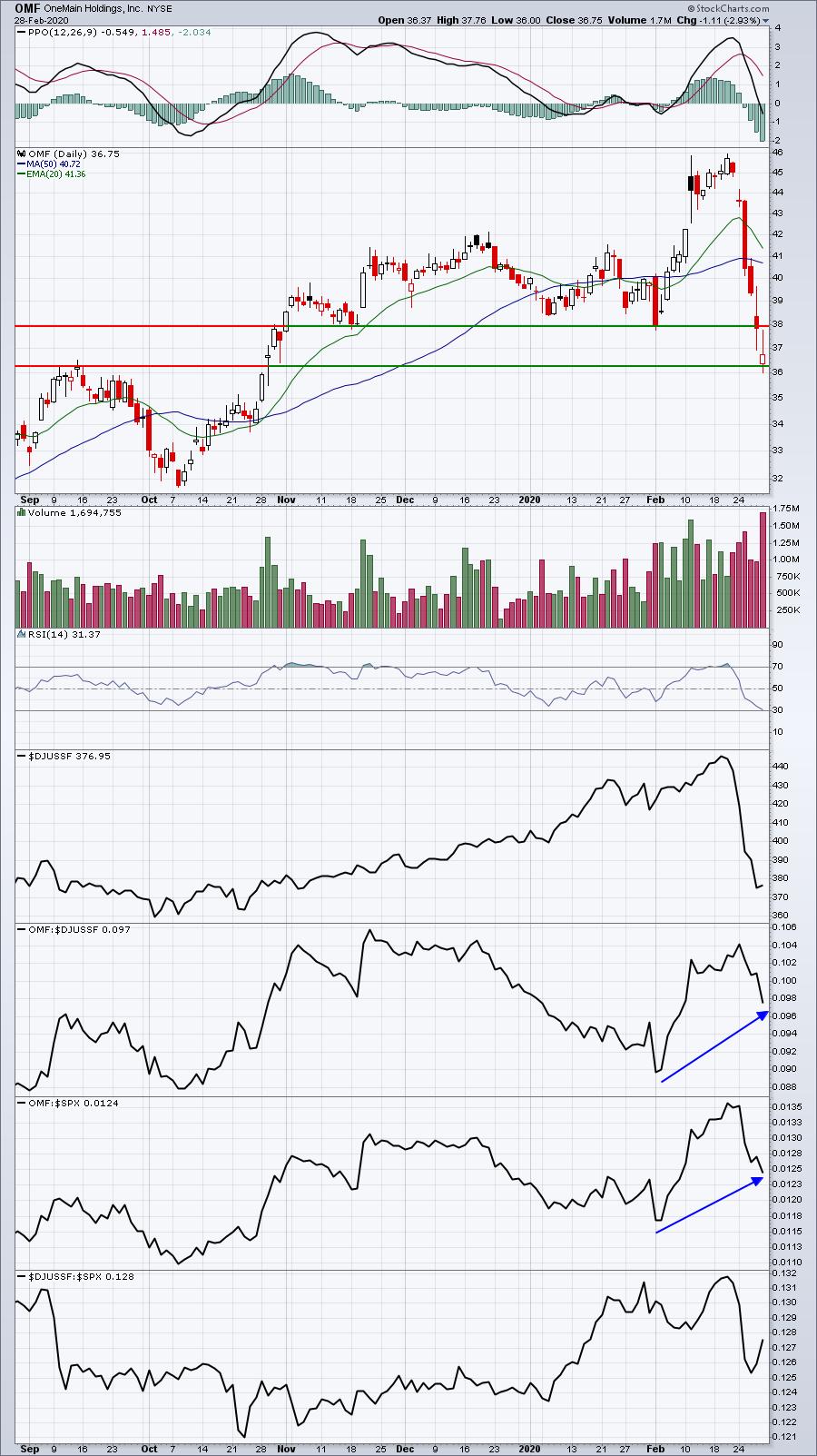
OMF had HUGE relative success for its peers throughout much of February, so giving back some of that last week isn't a big concern at this point. I'd look for a rebound here next week.
Character Change Portfolio:
The CC portfolio tumbled 10.68%, but did outperform he S&P 500 for the week. Here is the inception-to-date chart since November 19, 2019:
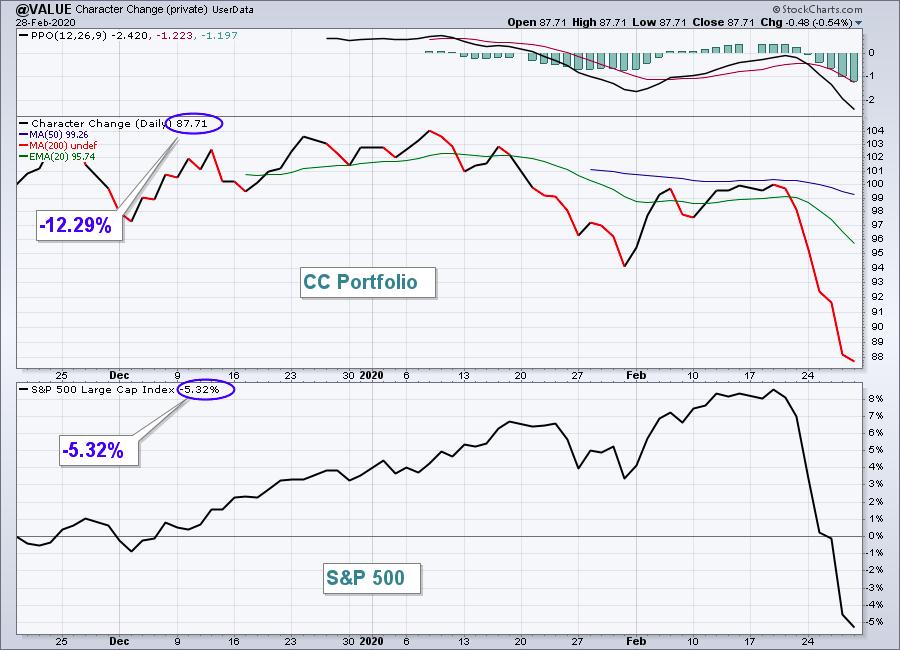
Here are how the CC portfolio component stocks performed last week:
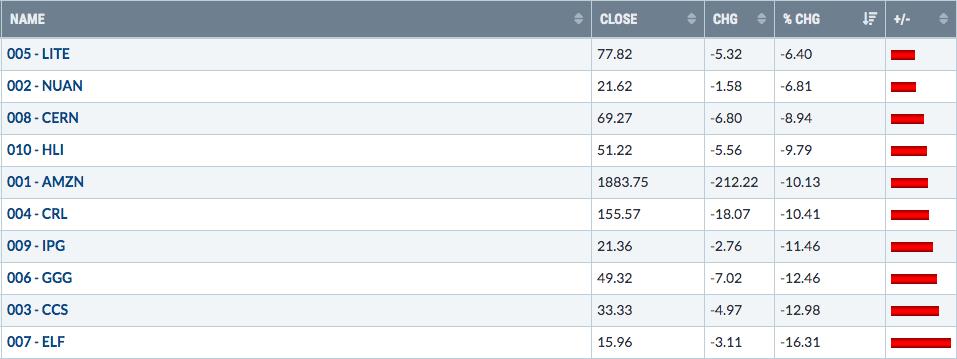
7 of the 10 component stocks here outperformed the S&P 500's decline, which was a good thing. If it can do the same on an S&P 500 rebound, the CC portfolio could begin to make up some of its underperformance since inception. ELF was the only significant underperformer and here's a look at its latest chart:
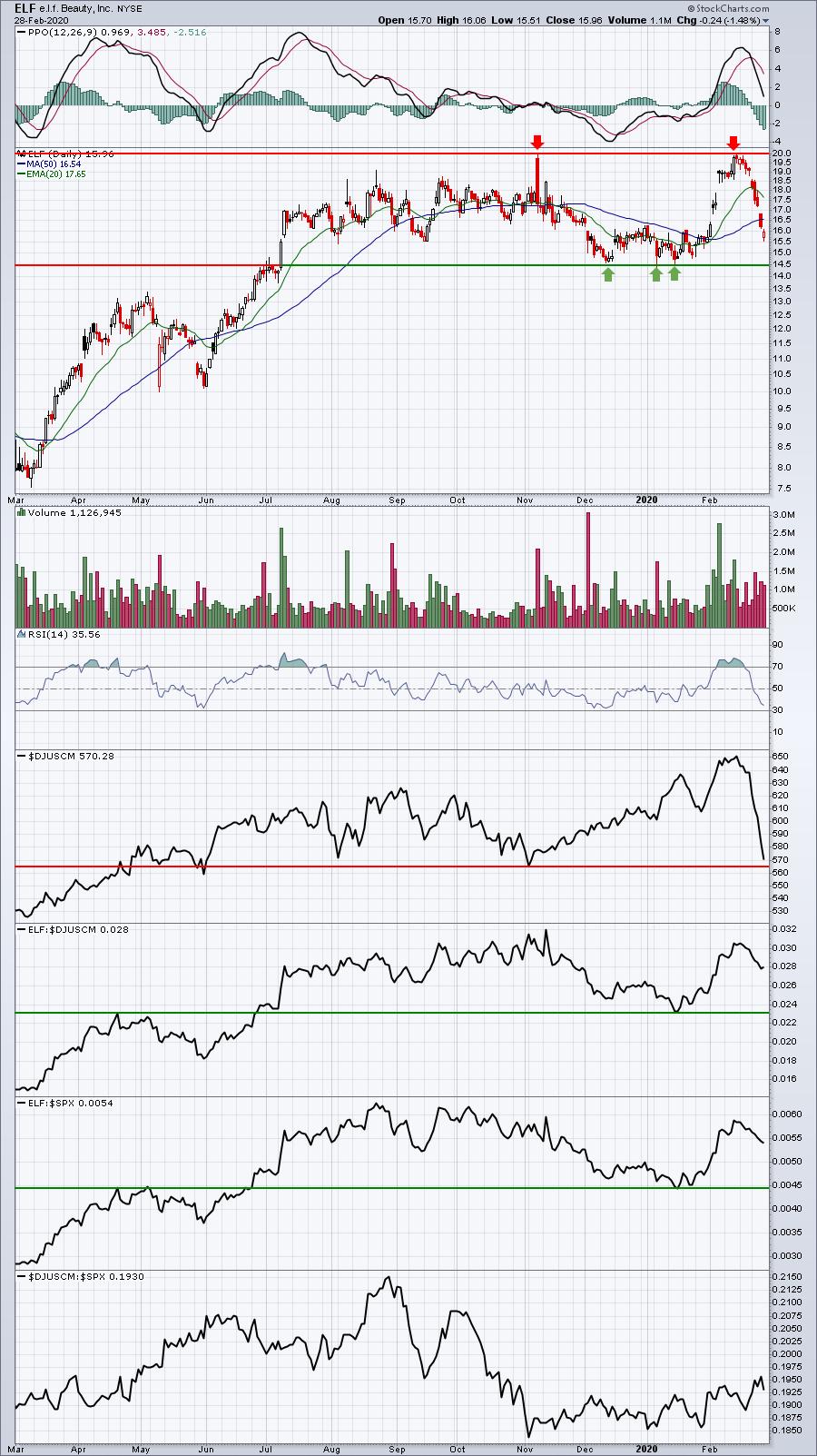
I'm still fine with the longer-term chart here. Yes, it was a bad week, but thus far, we're seeing price support hold and its relative strength still is quite solid vs. both its personal products peers ($DJUSCM) and the benchmark S&P 500. If those relative support lines fail to hold, then we'd have a different technical story.
Summary
There's really no sugar-coating it. It was an awful week for U.S. equities and our portfolios suffered just the same. On Friday, when the S&P 500 finally staged a bit of a recovery in the afternoon, 3 of our 4 portfolios outperformed fairly significantly on the rebound. The Income portfolio lagged very slightly on Friday.
My hope is that when U.S. equities enjoy a more sustained rally, our portfolios, comprised of relative strength winners, will see more than their fair share of money rotating in.
In the meantime, let me reiterate these portfolios are a long-term based strategy, with stock rotation every three months. There is no attempt to try to time the market with entries and exits. If your strategy is to try to time these major pivots in the market, then you're not truly a long-term investor. In my experience, the absolute worst thing you can do as a "long-term investor" is to panic out of positions when the Volatility Index ($VIX) rises to a level (49) like we saw on Friday. Many times those readings can mark a bottom, so getting out in panic mode really hurts your longer-term return.....and then you're stuck trying to figure out when to jump back in.
Hopefully, last week's fear settles down and we see a rebound in the week ahead.
Happy trading!
Tom Bowley, Chief Market Strategist
EarningsBeats.com
"Better timing. Better trades."