
EB Daily Market Report - March 31, 2020
Executive Market Summary
- Futures were relatively stable overnight and our major indices opened mostly flat
- Gold (GLD) is down 1.50% as dollar proxy (UUP) attempts rise for second straight day
- Crude oil ($WTIC) stabilizes, rising 2% to $20.48 per barrel
- Asian markets were mixed overnight, while European markets trade higher
- March Chicago PMI fell to 47.8 from 49.0 in the prior month, but that well above the consensus estimate of 40.0
- March consumer confidence also easily surpassed lowered estimates, 120.0 vs. 110.0; it still represented a 10% drop from February's revised 132.6 reading
- Energy (XLE, +2.69%) and communication services (XLC, +0.23%) were the only two positive sectors
- Relative weakness was found in both real estate (XLRE, -4.34%) and utilities (XLU, -3.27%)
- We have no active trade alerts at this time
Market Outlook
Our major indices are now approaching or moving into the first key Fibonacci retracement level at 38.2% of the prior downtrend. To illustrate, here's the current view of both the S&P 500 and NASDAQ:
S&P 500:
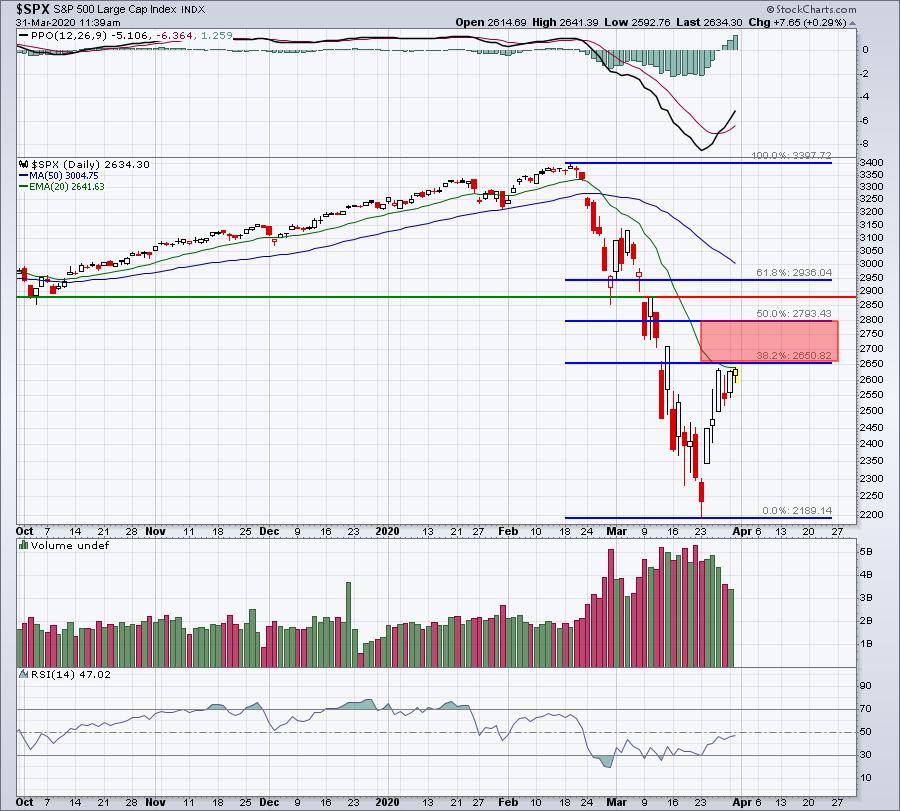
The S&P 500 is within about a 1/2 percent of that initial Fib level, which is close to 2650. For those who indicated they are interested in shorting or trading a leveraged (2x) inverse ETF like the SDS that benefits from the S&P 500 falling, I had previously discussed exercising patience to allow this rebound to run its course. Of course, we have no idea whether the SPX will fall back to prior lows, but history tells us that the next 5-6% of a potential rally could be quite difficult. Starting a position in the SDS from the current level and adding to it as the SPX rises toward the Fib 50% retracement level makes sense. Does it guarantee a winning trade? Of course not, but the reward to risk grows as the S&P 500 rises. Also, please keep in mind that prices have fallen significantly because the stock market believes we have a lot of economic uncertainty ahead....and it's hard to argue with that. But if we wake up to important and positive medical news, all bets are off as to whether we see a retest of prior lows. I want to stress to everyone that I still believe we remain in a secular bull market, despite the current cyclical bear market. That means that once this uncertainty passes, I fully expect the long-term stock market rally to continue, and possibly accelerate. At this point, any shorting should be concerned very short-term in nature and stops should be considered if the current rally extends beyond key Fibonacci levels.
NASDAQ:
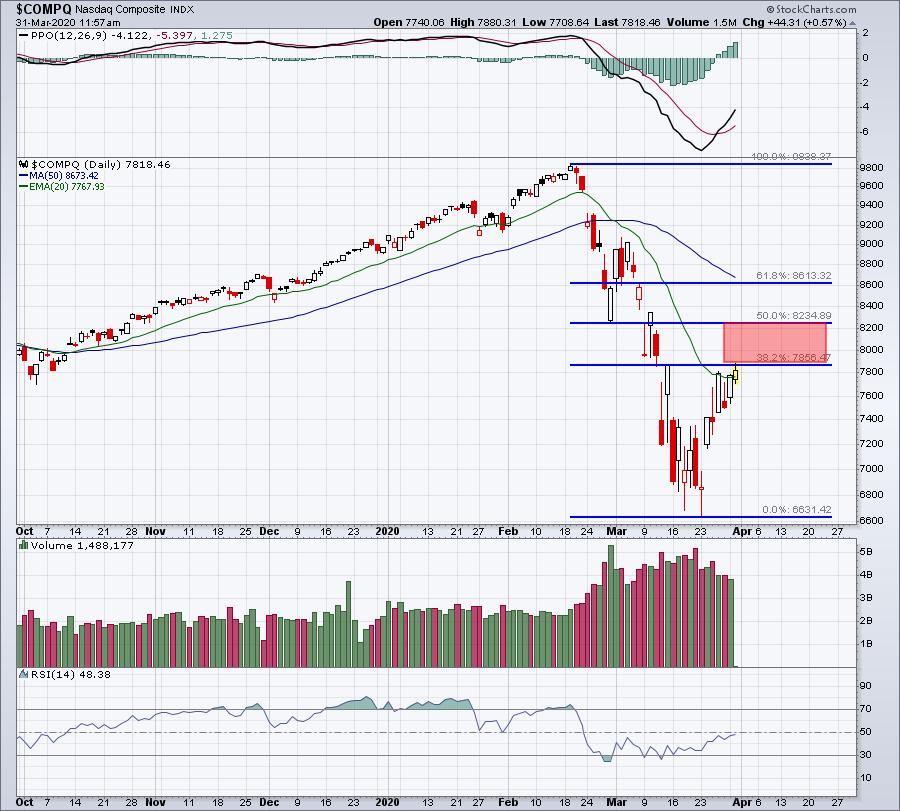
The NASDAQ has actually touched that 38.2% level, though it currently trades just beneath it. Like the SPX, however, the NASDAQ could run into difficulties over the next 4-5% of gains.
Trading Ideas
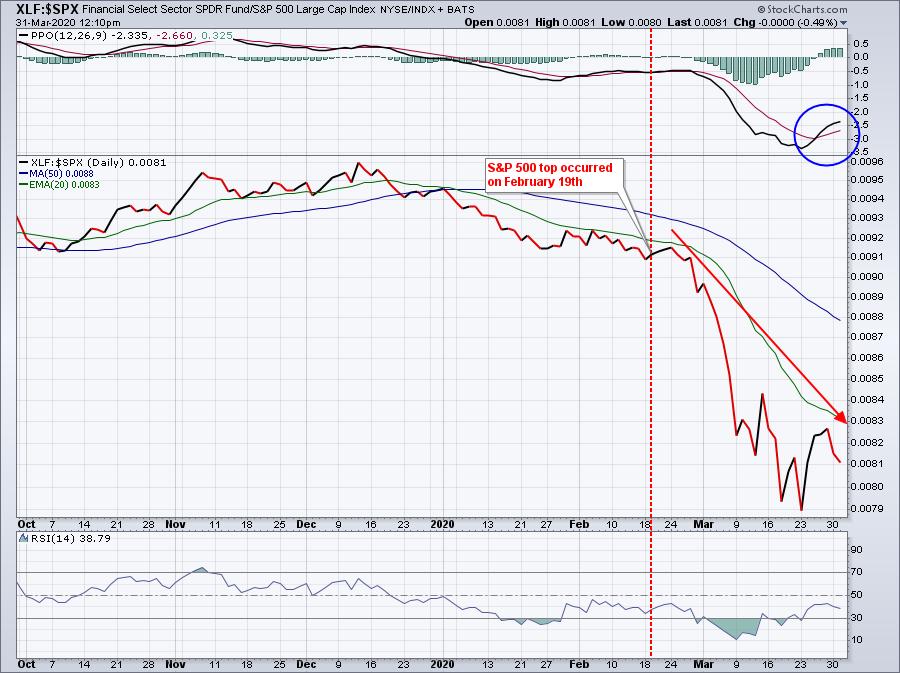
While I don't short individual stocks, especially in a secular bull market, I know many of you do. If I were to consider shorting, I would definitely want to focus on weak stocks in areas of the market that have been out of favor since the February 19th S&P 500 top.
As an example, consider the plight of financial stocks (XLF). First, they are in a severe downtrend vs. the S&P 500 as you can see below:
The next thing to understand about financials is that they historically underperform the benchmark S&P 500 when treasury yields are falling. Check out this chart:
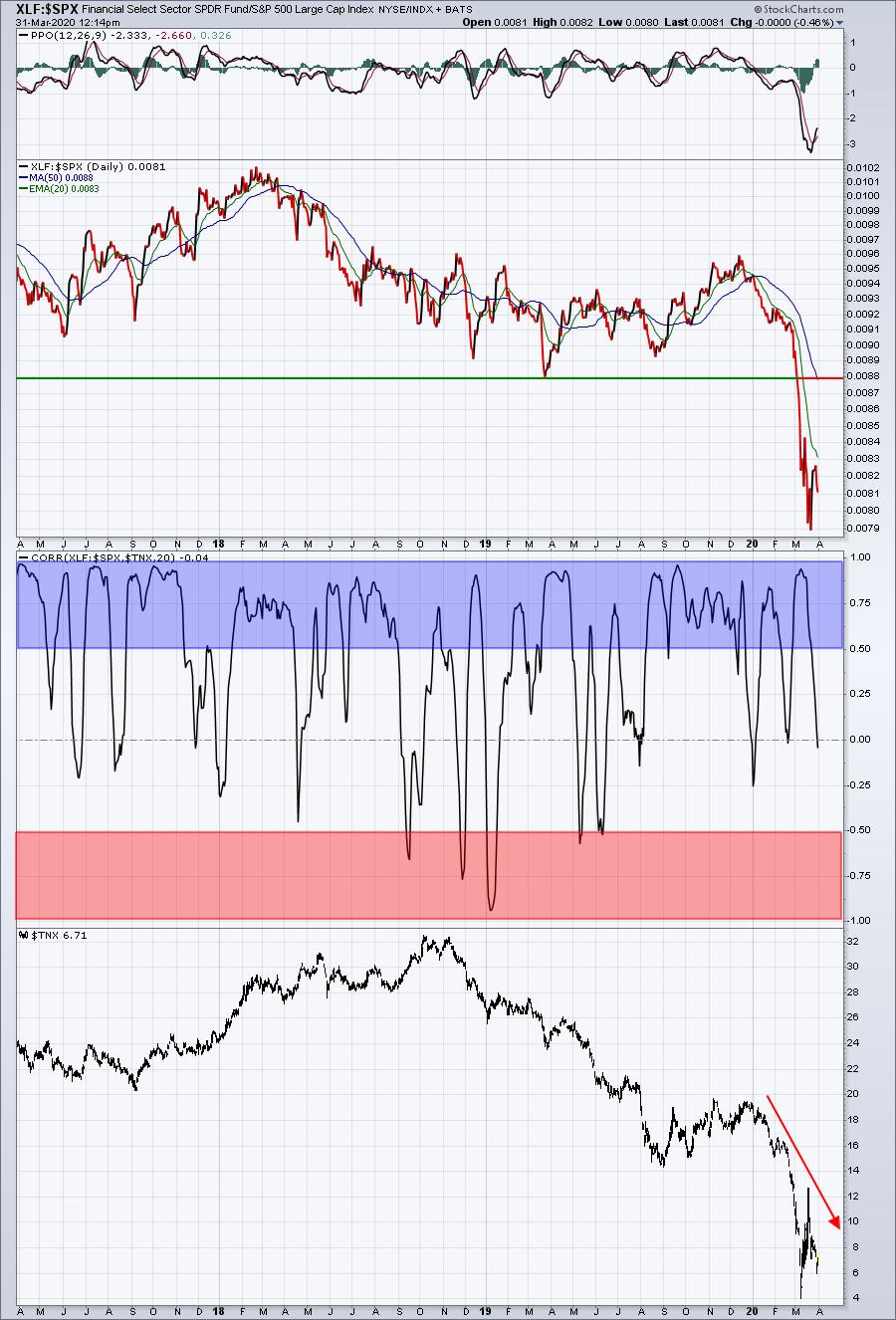
The top panel shows that financials are very weak right now relative to the S&P 500 (XLF:$SPX). The next panel show the correlation between the XLF:$SPX and the 10 year treasury yield ($TNX). The blue-shaded area shows when positive correlation is greater than 50. The red-shaded area shows when negative correlation is below -50. Clearly, there's a lot more positive correlation. In other words, when the TNX is downtrending, financials tend to underperform.
Finally, let's check out some of the lowest SCTR scores among large cap financials to help us identify potential shorting candidates in this sector:
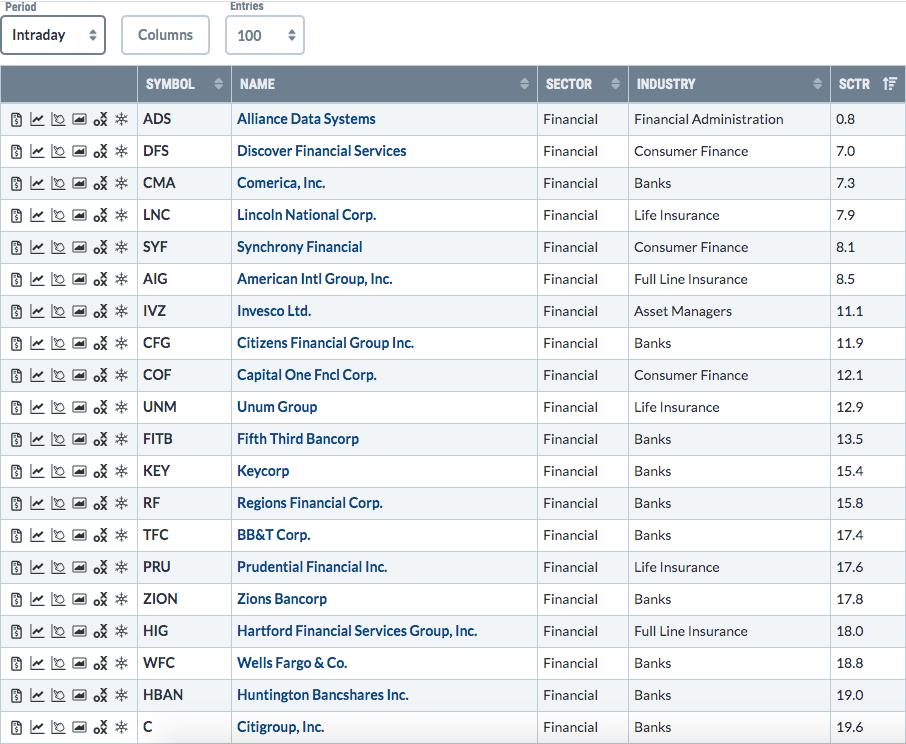
These are all the large cap financials with SCTR scores below 20, so they're relative underperformers. I looked at all of their charts and reviewed their accumulation/distribution lines and found the following of interest:
WFC (banks):
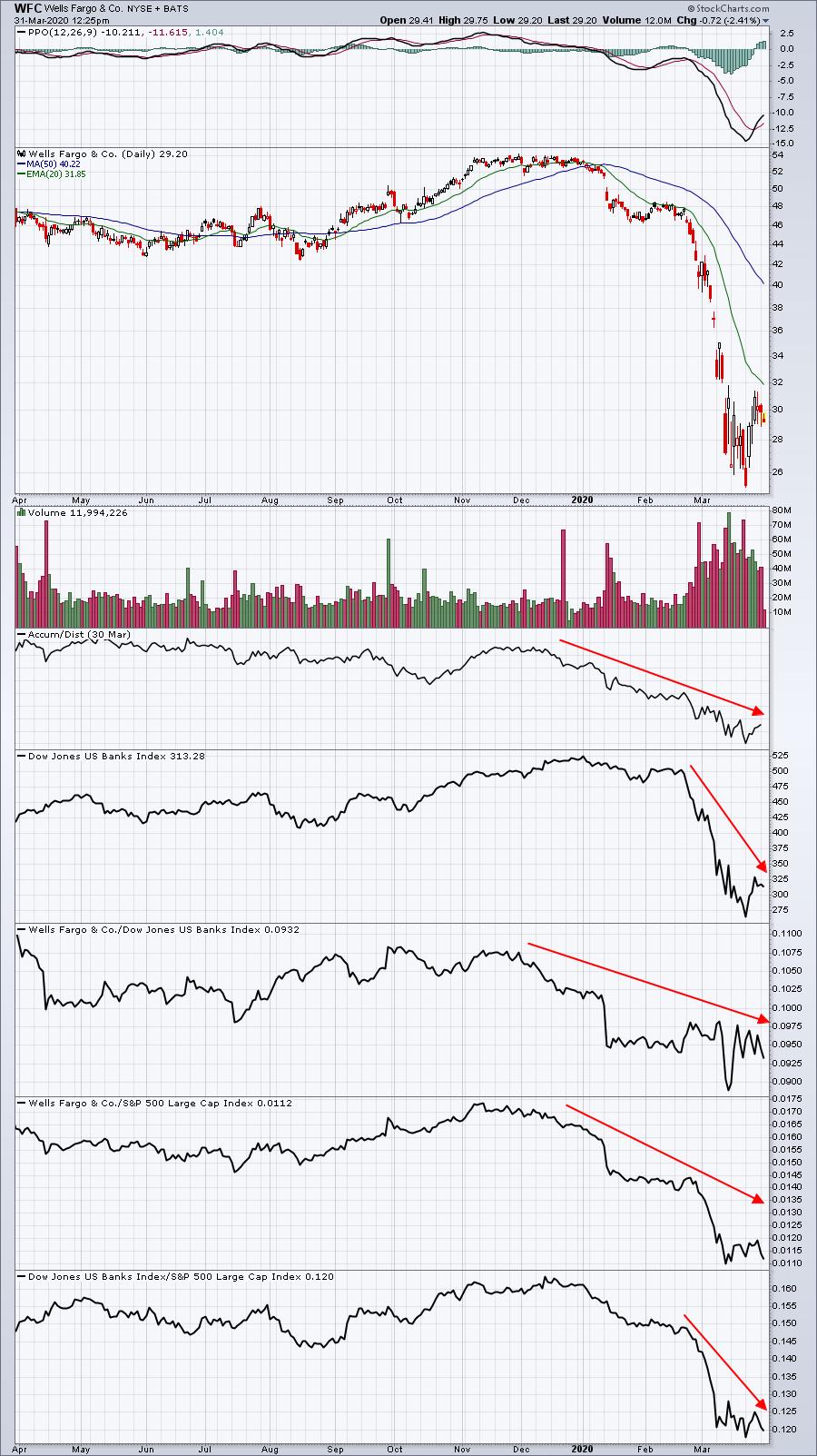
The bounce in WFC has been extremely weak compared to many financials. And check out the volume on the selling and the continuing drop in the accumulation/distribution line. Wall Street doesn't seem to care at all for Wells Fargo, so if I was to consider shorting, a stock like this would be high on my list. It would be best to catch it on an up day.
UNM (life insurance):
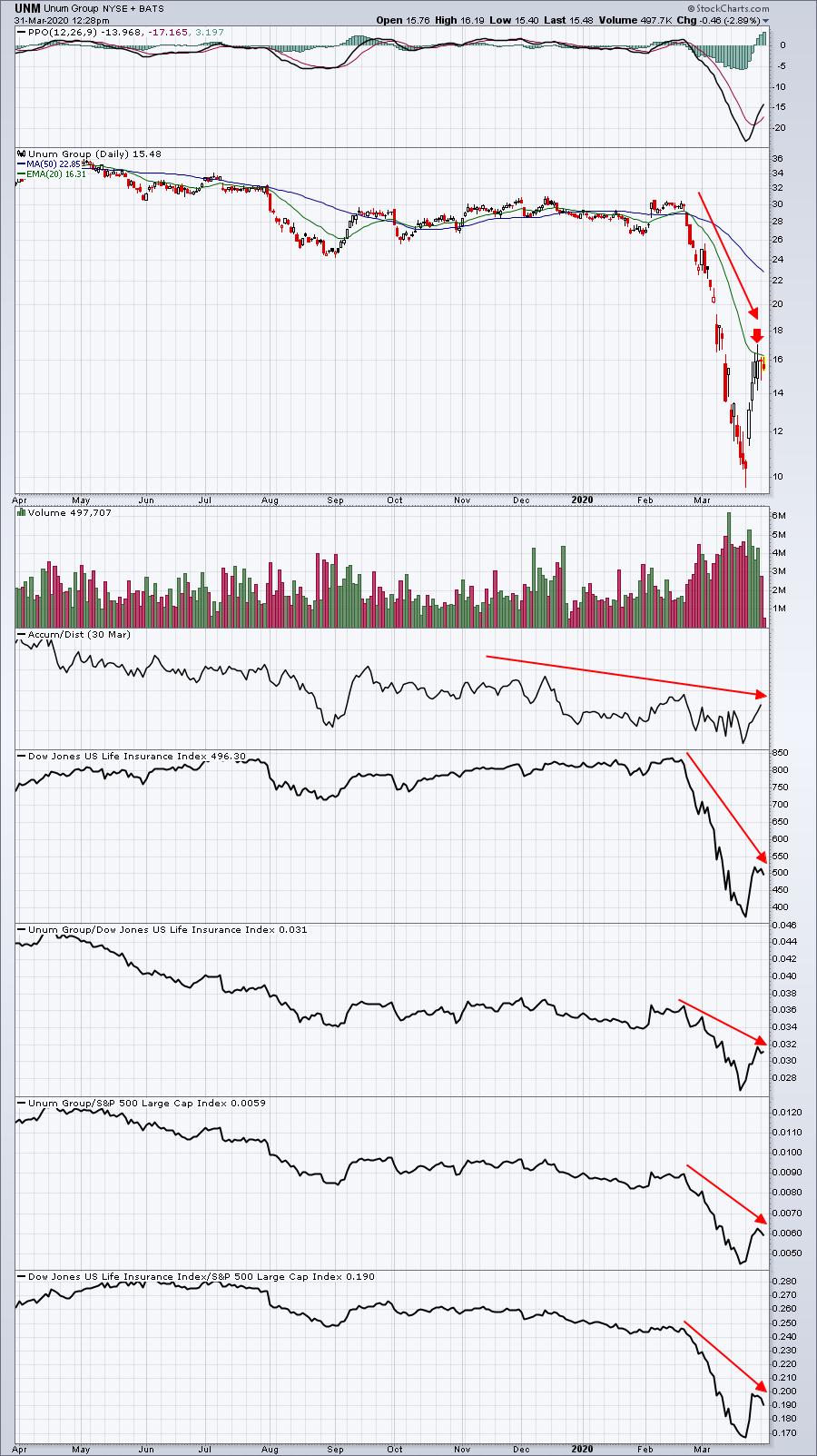
UNM looks similar to WFC and is completely out of favor with Wall Street. The failure at the 20 day EMA is typically a great entry point, but like WFC, I'd feel better about a short entry on a day where the stock shows early strength. Consider the recent price high as an area for a potential stop loss.
Happy trading!
Tom