
EB Daily Market Report - Friday, November 26 2021
Fall Special
Just a quick reminder that our Fall Special runs through tomorrow at midnight. If you'd like to see the details and savings, CLICK HERE.
Executive Market Summary
- Futures were down sharply overnight after a new COVID-19 variant emerged in South Africa
- The hardest-hit area is energy (XLE, -3.94%), though all 11 sectors are lower
- Financials (XLF, -2.93%) and industrials (XLI, -2.42%) are also very weak
- The 10-year treasury yield ($TNX) is down 14 basis points to 1.51% as money rotates to safety (bonds)
- Travel stocks ($DJUSTT, -5.46%) and crude oil ($WTIC, -11.80%) are down significantly
- Cryptocurrencies are also taking a beating with etherium ($ETHUSD) falling more than 9%
- Gold ($GOLD, +0.06%), a safe haven, is close to unchanged
- Defensive sectors like health care (XLV, -0.08%) are leading on a relative basis
- Much, much more below
Market Outlook
Well, I had planned to take it easy today and perhaps send out a quick, abbreviated DMR. But the stock market is not being kind, so I felt it necessary to provide you a more thorough DMR instead.
A new COVID-19 variant has emerged in South Africa and global equities tend to take a "sell first, ask questions later" approach. It doesn't help AT ALL that we recently had the Volatility Index ($VIX) warning. That was a signal that market participants were growing more nervous as prices rose. As I discussed last week, I look at that development as the market telling us that it won't handle any bad news well. Today, there's little in the way of earnings news and nothing in the way of economic news, so those traders that are participating on this holiday-shortened, Black Friday trading session are reacting, possibly overreacting, to this news out of South Africa. We know very little about the danger imposed by this new variant as scientists just recently discovered it. As more news surfaces, we'll be better able to assess the ultimate economic impact. Unfortunately, however, when fear escalates, the stock market sells off HARD and usually over brief periods of time.
I will say exactly the same thing that I said more than 18 months ago in March 2020. COVID-19 is a health care issue and should not be construed as a financial issue. Can it have short-term financial implications? Of course, but they are not long lasting. So any future discussion about this new COVID-19 variant would not impact "buy-and-hold" long-term investing decisions, in my opinion. For traders, well of course there's financial impact. We try to avoid huge downswings and protect capital (or sell short if you're a very aggressive trader).
I believe the key is not what happens at the opening bell, as the stock market routinely takes advantage of those who react to market behavior and sell when they're losing money. But the action throughout the trading day will tell us which areas are being distributed and more vulnerable and which areas are being accumulated. Nearly every stock, except those that benefited in 2020 from lockdowns and restrictions, opened lower today. Many have continued to sell off AFTER the opening bell. That is much more of a sign of distribution, though reading too much from market behavior on Black Friday can be dangerous because volume tends to be much lighter.
Those EarningsBeats.com members that have been with us since the early stages of the pandemic probably recall the "Pandemic Index" that I tracked for a year or so. I used StockCharts.com's tool, the User-Defined Index, to track the performance of the 10 worst performing industry groups. They included airlines ($DJUSAR, -9.14%), recreational services ($DJUSRQ, -10.53%), hotels ($DJUSLG, -7.76%), aerospace ($DJUSAS, -6.97%), travel & tourism ($DJUSTT, -7.38%), hotel & lodging REITs ($DJUSHL, -9.22%), oil & equipment services ($DJUSOS, -7.08%), and a couple others. The percentages in the parenthesis represent today's performance with the new COVID-19 news. Yes, we've seen big drops in these areas, but further bad news and negative headlines regarding COVID-19 is likely to have a much bigger impact in these areas. Holding stocks in these groups represent the highest risk, in my opinion.
The 10-year treasury yield ($TNX) is down nearly 15 basis points to 1.50%, which is having a very negative impact on financial (XLF, -3.77%) and industrial (XLI, -3.04%) stocks. These two groups trail only energy (XLE, -5.72%) as crude oil prices ($WTIC, -11.49%) have dropped below $70 per barrel for the first time since mid-September.
I wish I had a crystal ball and could predict the flow of news about COVID-19, but I cannot. The stock market will be driven in the short-term by fear, or lack thereof. We are seeing intraday breakdowns in the short-term on our major indices. The following is 2-month, hourly chart of the S&P 500 and NASDAQ, showing you the short-term price support levels discussed earlier this week, along with relative strength charts showing that growth stocks remain in favor:
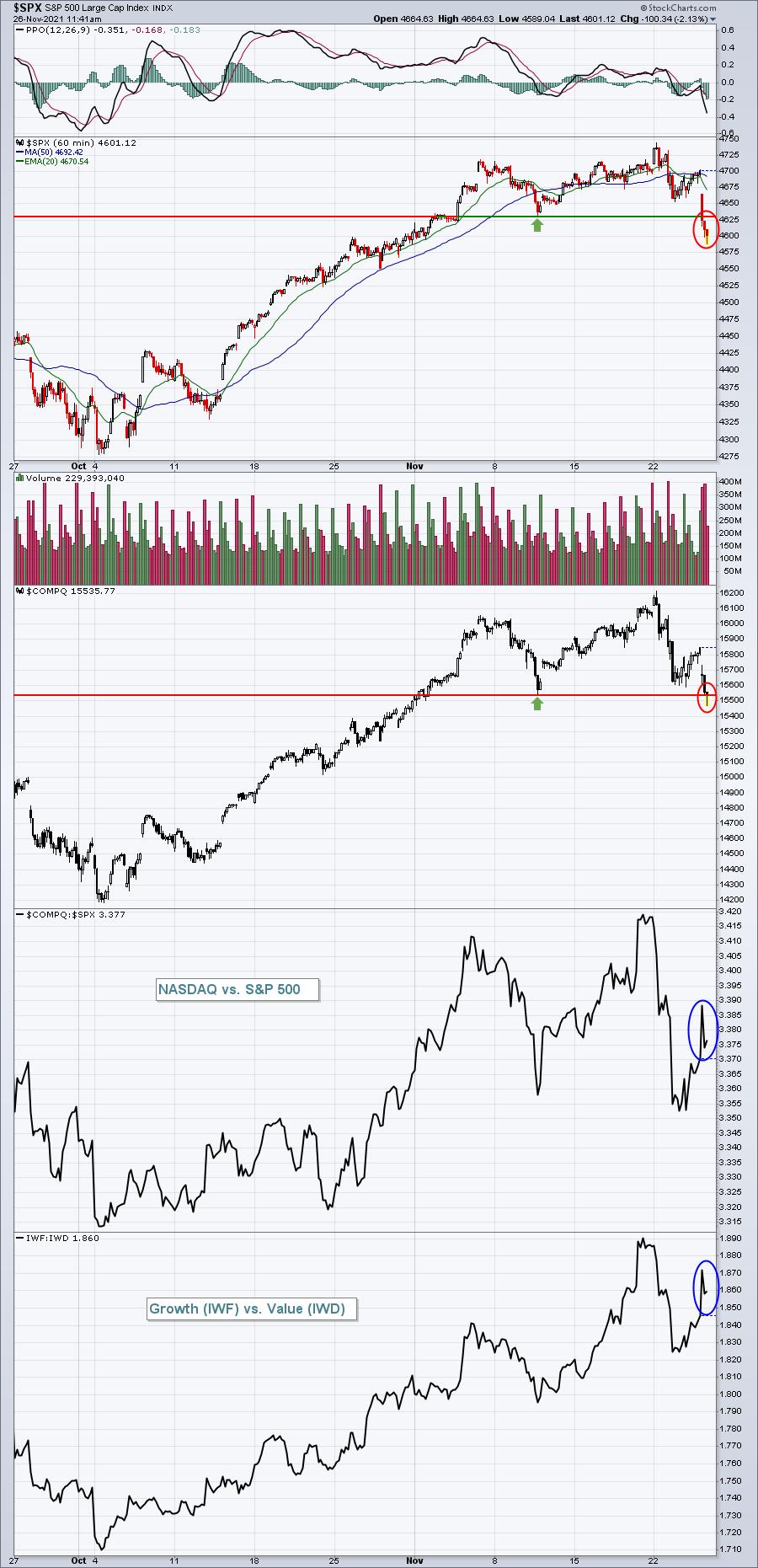
We're seeing intraday breakdowns of short-term price support, but rotation is favoring growth stocks. That's exactly how the market behaved in March 2020. I believe today's reaction is completely overblown. However, that and $7 can get you an Extra Value Meal at McDonald's when it comes to fear and short-term market behavior. A rising VIX can assure us that very little is rational.
My point is I honestly don't have any clue about the short-term. The Dow Jones could be up 1000 points on Monday morning or it could be down another 2000. The stock market is irrational in this type of environment.
Cash is the safest place to be, but not necessarily the best.
Sector/Industry Focus
In any market decline, my focus turns to the Volatility Index ($VIX), which will spike exponentially vs. the S&P 500's decline. For instance, today the SPX is down 2.23% (at last check), while the VIX is up 49%. The history of the VIX tells us that trips into the mid-30s tend to coincide with excellent buying opportunities. We have no guarantee that the VIX will reach that level, but most trips there tell us that the majority of fear has been built into equity prices. To illustrate, check out this chart:
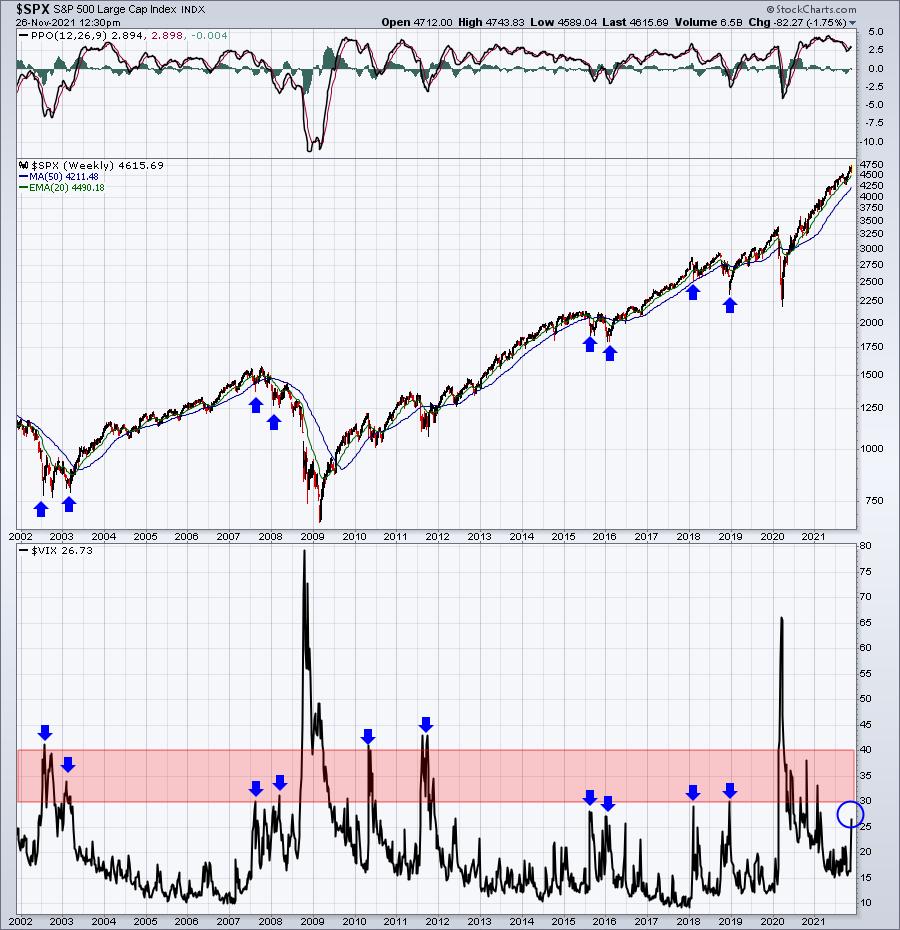
We've seen higher readings obviously, but once you move into the 30s, you can see that it's fairly rare. And the extreme readings in 2008 and 2020 occurred with extremely uncertain times - the financial crisis and the initial pandemic concerns.
ChartLists/Strategies
I own a few stocks in areas of the market being trashed today. Stocks that I mentioned on Wednesday like LYV, M, ABNB, are all being flushed today. Whether or not these stocks should be sold is really a personal decision and depends a LOT on how much risk you're willing and able to take. Clearly, the most conservative action to take today is to sell everything and simply watch for now to see how the stock market reacts in coming days to news. Personally, I'd feel better about holding individual stocks that saw most or all of their selling at today's open and rebound somewhat by the closing bell. That will increase their AD lines and, if you recall, that was the absolute best technical indicator to follow during the height of the 2020 pandemic.
Taking losses and moving to the sidelines also carries very high risk as well. What if we hear word over the weekend that scientists believe vaccinations are helpful in combating this new variant? Suddenly, the stocks down 10% today could gap up 10% on Monday. But if the news is more damaging, and with the VIX already up 52% today to 28, we could see a Monday morning meltdown. This has nothing to do with a company's earnings, outlook, product, competitiveness, etc. It has everything to do with significantly increasing or declining fear. I look at it as a coin toss.
I am not a Registered Investment Advisor (nor is EarningsBeats.com) and cannot provide advice. I can only tell you that my experience tells me that when the VIX is elevated and rising, there's VERY SIGNIFICANT short-term market risk in holding or adding positions. The best way to avoid the near-term risk (in both directions) is simply to sit it out and stay in cash.
I am not adding ANYTHING today. I was already much lighter in terms of trading positions, because of what I've discussed recently. But I do own positions and I'm personally not moving entirely to cash. But I will evaluate every position just before the close and determine which positions I'm uncomfortable holding over the weekend.
Earnings Reports
Here are the key earnings reports for the next two days, featuring stocks with market caps of more than $10 billion. I also include a few select companies with market caps below $10 billion. Finally, any portfolio stocks that will be reporting results are highlighted in BOLD. If you decide to hold a stock into earnings, please understand the significant short-term risk that you are taking. Please be sure to check for earnings dates for any companies you own or are considering owning.
Friday, November 26:
PDD
Monday, November 29:
LI
Economic Reports
None
Happy trading!
Tom