
EB Daily Market Report - Monday, July 11, 2022
Model ETF Portfolio - Sneak Preview
Later this afternoon, at 4:30pm ET, I'll be discussing our approach to our Model ETF Portfolio. I'll be discussing current market themes, the history of sector performance during various bull and bear market periods, and sector and industry group rotation. I hope you'll be able to join me!
If you can't make it, no worries. We'll record the event as we always do and make it available for you to watch at your convenience.
Executive Market Summary
- Futures were weak overnight and our major indices all gapped lower to start the week
- The NASDAQ has clearly been the weakest index, although its relative strength has improved since the first 30 minutes
- Overall action has favored value (IWD, -0.47%) vs. growth (IWF, -1.10%), though the latter has also shown relative strength improvement since the opening 30 minutes
- Defensive sectors are today's outperformers, with utilities (XLU, +0.38%), consumer staples (XLP, +0.14%), health care (XLV, +0.07%), and real estate (XLRE, +0.02%) the four sectors in positive territory
- Meanwhile, communication services (XLC, -2.37%) and consumer discretionary (XLY, -2.04%) are the hardest hit
- Gambling ($DJUSCA, -5.14%) and automobiles ($DJUSAU, -5.13%) are both very weak; the latter is likely seeing profit taking after a very strong week last week
- The 10-year treasury yield ($TNX) is down 10 basis points to 3.00% today as the volatility continues in the bond market
- Earnings season will kick off later this week with JP Morgan (JPM) and several financial companies set to report their quarterly results
- Economically, we'll get two big inflation reports later this week - the June CPI (Wednesday) and June PPI (Thursday); these two reports will likely have traders on pins and needles
Market Outlook
For me, trading/investing is all about risk analysis, not guarantees. It's difficult to predict whether the S&P 500 is going to go up or down on any particular day. We can use momentum indicators like the PPO and trend-following overlays like moving averages for clues, but the stock market does things that we don't expect often. So you should analyze RISK first and foremost based on your overall belief in market direction and then determine where it makes sense to be more aggressive and where it makes sense to simply sit back and watch with much less capital at risk.
I think you probably understand by now that I believe we've bottomed and will move higher. But I can't tell you whether we'll go straight up or whether we'll sideways consolidate. Will we see a double bottom to test that June low on the S&P 500? Honestly, I don't know.
But here's what I do know. If we ARE trending higher and today's weakness is simply temporary, we should be looking for a successful 20-day EMA test. On the NASDAQ 100 ($NDX), that means current price would be a GREAT entry if you're betting on a bounce off of the 20-day EMA. If this test fails, then you should be thinking, "I need to lessen my risk." I've discussed recently that the short-term risks were too high to leverage on the long side with, say the QLD, because that tracks the NASDAQ 100 at a 2x clip. If the NDX simply fails at the 50-day SMA, being in the leveraged QLD will cost you twice as much as simply riding the QQQ. After today's early selling, I took a small position in the QLD and will hold so long as the 20-day EMA holds on the NDX. This is what it currently looks like:
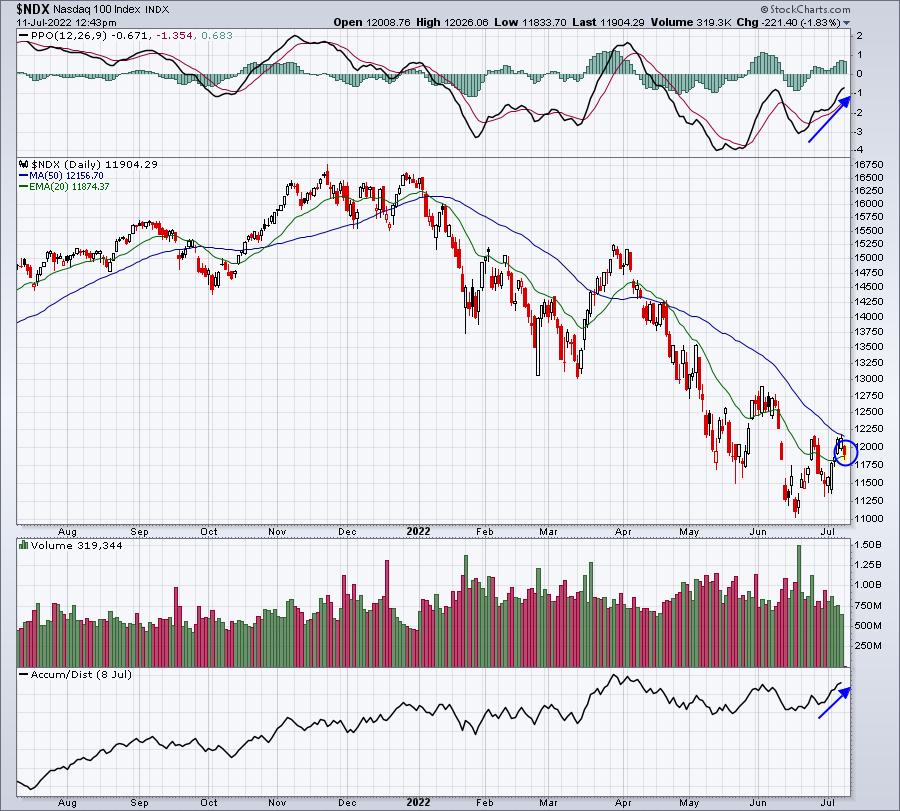
Do we hold that 20-day EMA (blue circle) at the close today? If so, then the argument that we're trending higher remains alive and well. If we fail to successfully hold the 20-day EMA, then that argument is somewhat tainted. A downtrend can only begin if we fail to hold the rising 20-day EMA. If that failure occurs, the risk of holding a leveraged, 2x ETF rises significantly. It doesn't mean it won't bounce back and there won't be whipsaw. You're simply eliminating the risk of a more significant decline ruining your portfolio.
You should never confuse managing risk with providing any sort of guarantee about future market direction.
Sector/Industry Focus
Earlier this morning, shortly after the opening bell, I saw a headline on cnbc.com that said (and I'm paraphrasing a bit), "Stocks are down as technology gets killed". Again, I'm paraphrasing and I should have taken a screen shot. But headlines can be so misleading. Are technology stocks struggling today? Yes. Are they getting killed? I wouldn't say that. Technically, we're actually seeing the XLK fall back to successfully test (so far) its rising 20-day EMA. Check this out:
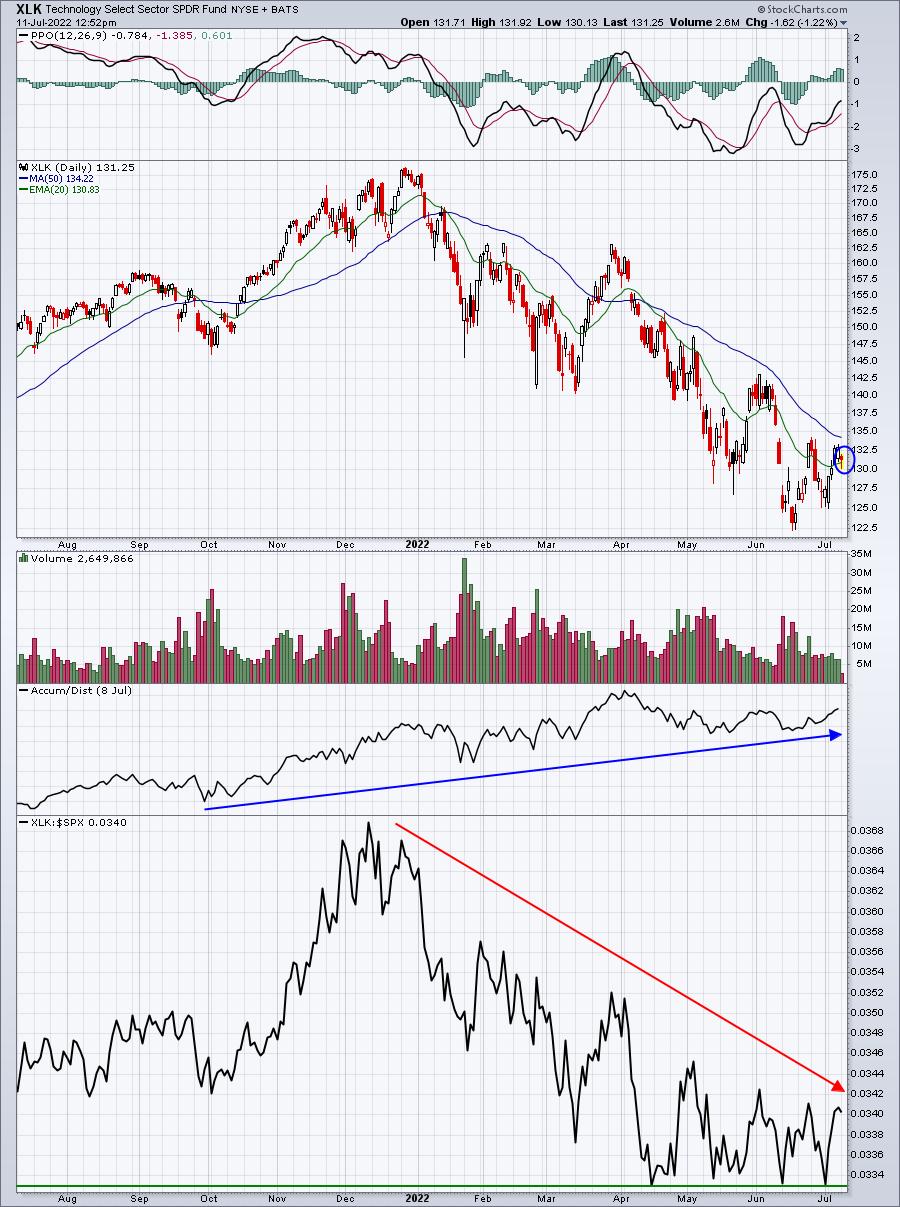
Technically, this is the best time to buy the XLK, in my opinion. If it falls back beneath the 20-day EMA on a closing basis, you simply exit with a small loss. The truly NASTY behavior of the XLK would include a relative breakdown beneath those relative lows from April through early July. It would also include a breakdown of the AD line (instead of the higher lows we've been seeing throughout 2022). And it would include failure on this short-term 20-day EMA test. But again, folks who do not follow EarningsBeats.com specifically, or technical analysis in general, see these gloomy headlines and accept them as fact. Things are improving in the stock market and have been the past 8-10 weeks, but you'll never know it from the media.
I will give you one example of how the media skews the news. I clicked on the cnbc.com tab to show Asian markets and I want you to look at the 5 markets CNBC provides and then check out the one market (of those 5) they point out:

The Hang Seng Index ($HSI) is, by far, the worst performer and that's the one that CNBC discusses in the headline. Why not discuss the fact that the NIKKEI ($NIKK) hit a one-month high and was up more than 1%? Well, that just doesn't get you many clicks. This is the reason why investors' attitudes change and why sentiment changes. These "news stories" wear on everyone over time. We begin to believe there is no way out of all the horrible things we face. Our portfolios are down, our mindset is bearish, and now the stock market MUST go lower to confirm how badly we're feeling.
And it does.......for awhile. And then Wall Street buys all of those beaten-down shares and disguises it via rotation and and improvement in relative strength.
Fortunately, we don't fall for that any longer.
ChartLists/Strategies
Let's talk more strategy. As I discussed in Friday's DMR, remaining leveraged as risks escalate is not something I'm willing to do. While I will no longer short ANYTHING, because I believe the bottom is in, I will pick my spots to grow more aggressive. I don't want to short to try to catch a pullback in a rising market. While the trend was lower and our sustainability ratios favored further declines ahead, shorting was appropriate. But now that those sustainability ratios have made their case for a market bottom, I'd need to see a lot more bearish behavior before I'd give up on my bottom call from mid June. Instead, I'd grow more aggressive on the long side when we pull back - like today.
I actually bought a small position in the QLD on the NASDAQ 100's 20-day EMA test today that I illustrated above. At market bottoms, I generally prefer to trade ETFs. Individual stocks can make you much more money, but there is little more frustrating to me than getting the market direction right and losing money, because I picked the wrong stocks. Any kind of a bounce anywhere near the recent price high and I'd take the small QLD profit and move back to the sidelines. If the QLD closes beneath the 20-day EMA, I'll exit. No questions asked. If I'm wrong about my bottom call, the LAST thing I want to do on the next leg lower is hold onto a leveraged ETF like the QLD. The only time I want to own a leveraged ETF is when it is TRENDING. I never buy and hold them over the long-term. Leveraged, or juiced, ETFs lose value over time due to erosion. Derivatives are used in order for these leveraged ETFs to work the way they do. Time and volatility both work against you when you hold a leveraged ETF long-term. Please understand that and be careful with them.
Earnings Reports
Here are the key earnings reports for the next two days, featuring stocks with market caps of more than $10 billion. I also include several companies with market caps below $10 billion. Finally, any portfolio stocks that will be reporting results are highlighted in BOLD. If you decide to hold a stock into earnings, please understand the significant short-term risk that you are taking. Please be sure to check for earnings dates for any companies you own or are considering owning.
Monday, July 11:
ETWO, GBX, AZZ
Tuesday, July 12:
PEP
Economic Reports
None
Happy trading!
Tom