
EB Daily Market Report - Special Report on Small Caps and Biotechs - Tuesday, July 8, 2025
I receive numerous requests from members, asking me about my position on small caps - whether I'm investing in the IWM, which tracks the small cap Russell 2000 index, or the TNA, which is a leveraged ETF that tracks the IWM at a 3 to 1 clip, or some combination of both. Let me first say that I, nor EarningsBeats.com, is a Registered Investment Advisor (RIA), meaning that we are not licensed to provide advice or recommendations. So please understand that when I discuss my trading strategies, it is for educational purposes only.
As part of my trading strategy, I regularly use leveraged ETF products to bolster my returns. I am willing and able to take on much higher risk and I accept the gains or losses that result from this type of trading strategy. Leveraged ETF products are DANGEROUS. There is the obvious threat that losses can triple if a directional call is incorrect. There is also erosion in leveraged ETFs, much like options, when they are held for longer periods of time. You MUST always realize that leveraged ETFs are designed to track their underlying securities for ONE DAY ONLY. As an example, if the IWM gains 3% over a 6-month period, the TNA will likely return MUCH LESS than 9%. In fact, there's a very strong possibility that the TNA will lose money. It's simply the way these leveraged products are constructed. Again, they are NOT designed to be held for the long-term.
I am a big fan of the small caps right now, because I believe there'll be heavy rotation towards this asset class if I'm right about the Fed cutting rates and doing so sooner rather than later. So after determining how much I want to risk in small caps, I then have the decision to make between the IWM and the TNA. When I believe the potential reward significantly outweighs the potential risk, then I want to move money from the IWM to the TNA. When the opposite is true, I'd much rather be invested in the IWM than the TNA. Hopefully, that makes sense.
All trades that I make between the IWM and TNA are based off the IWM chart. This is very, very important. I NEVER buy or sell the TNA based on its own individual chart, because it doesn't trade off technical price developments. It ALWAYS follows the action on the IWM. Therefore, my trading strategy will be based on the IWM chart, not the TNA chart. Here's the current IWM chart:
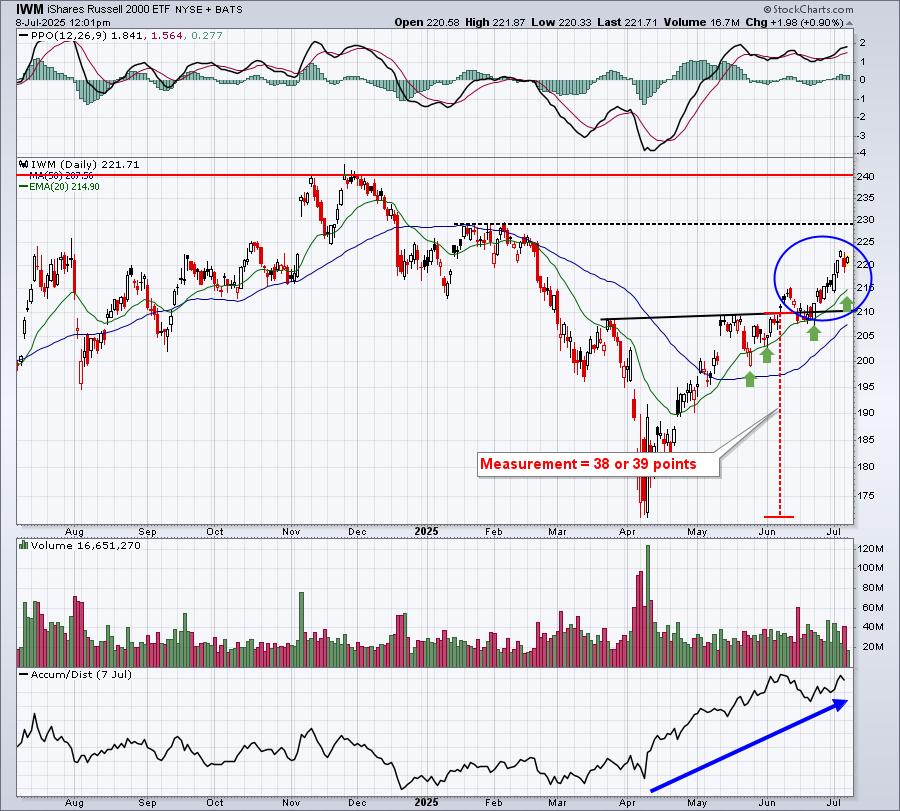
If you go back to June 23rd, you'll see a green arrow marking a 20-day EMA test. Any time you're bullish an underlying index or ETF that has a leveraged ETF product, a 20-day EMA test can serve as an exceptional time to take on the additional risk of a leveraged product as the downside is limited. A close below the 20-day EMA and I can quickly exit a leveraged product, limiting my 3x losses. If in a leveraged ETF product that's working to the upside, it's important, in my opinion, to identify price levels where selling might kick in. In the case of this IWM chart, I've identified 229 and 241 as key price levels where we've seen prior resistance and selling. Personally, I'd be very likely to sell the TNA and move into the IWM on either of these two price resistance tests. That way, if there is failure, I move lower with the much-less-aggressive IWM after profiting 3x on the way up with the TNA. That's the perfect scenario.
From a longer-term perspective, I like the reverse head & shoulders breakout as it measures to a target near 250. The target is calculated by adding the measurement (38 or 39 points) to the breakout level around 210/211. That's an exciting target and one I'd love to see hit. And if it does ultimately reach that level, I can make a lot more money in the TNA than I can in the IWM. However, there is plenty of risk involved - namely the 3 to 1 risk. We can't simply make this trade, thinking only about the 3x profit. We have to consider the potential of 3x loss as well.
I am currently in the TNA as opposed to the IWM, but that can, and likely will, change at a moment's notice. I will sometimes move back and forth between the IWM and TNA multiple times in a day, following intraday 10-minute charts. Sometimes, I'll stick with the TNA so long as the IWM continues to print higher intraday lows from day to day. There are many reasons why I might move back and forth, so sending out messages to members at every decision point will grow increasingly confusing for EB members and it's not something I'm interested in doing. What I will send out, however, is if I believe the long-term bullish picture for small caps, in general, changes.
As for whether the leveraged TNA makes sense for members, I believe that's a personal decision based on a number of factors, with the most significant being willingness and ability to accept much higher risk associated with the TNA. These leveraged products can move very quickly and, as I mentioned above, do carry other risks such as erosion, if held for longer than one day.
In closing, I believe the best time to enter leveraged products is on a key test of support on the underlying index/ETF OR on a breakout above key resistance on the underlying index/ETF.
I hope this helps to clarify my current position and provides key factors to consider before taking on the added risk of leveraged products.
One last thing. Should the XBI (biotechs) break out above 86, the leveraged LABU could explode to the upside as its 3x leveraged product. Just please be aware that biotechs can be extremely volatile and owning a security that moves 3x this group can be one very wild ride.....potentially in both directions. Currently, I own a small piece of LABU off XBI's latest 20-day EMA test, but would likely add to this position on the aforementioned breakout.
Happy trading!
Tom