
EB Daily Market Report - Special Update - Tuesday, September 29, 2026
I wanted to send this out early today as I've begun building an aggressive position in the leveraged 3x ETF (TNA) that tracks the small caps (IWM). A less aggressive position would be to simply buy the IWM, if you like the reasoning below.
Since the Fed was first rumored to begin hiking the short-term fed funds rate back in August, the 10-year treasury yield ($TNX) started to accelerate higher. With those higher yields, interest-rate-sensitive areas like the IWM, KRE, XHB, IYT, etc. have sustained significant declines. While timing the exact bottom in these areas is never easy, there are three signals that tell me the time could be now or very soon.
TNX Hits 2007 Yield Resistance
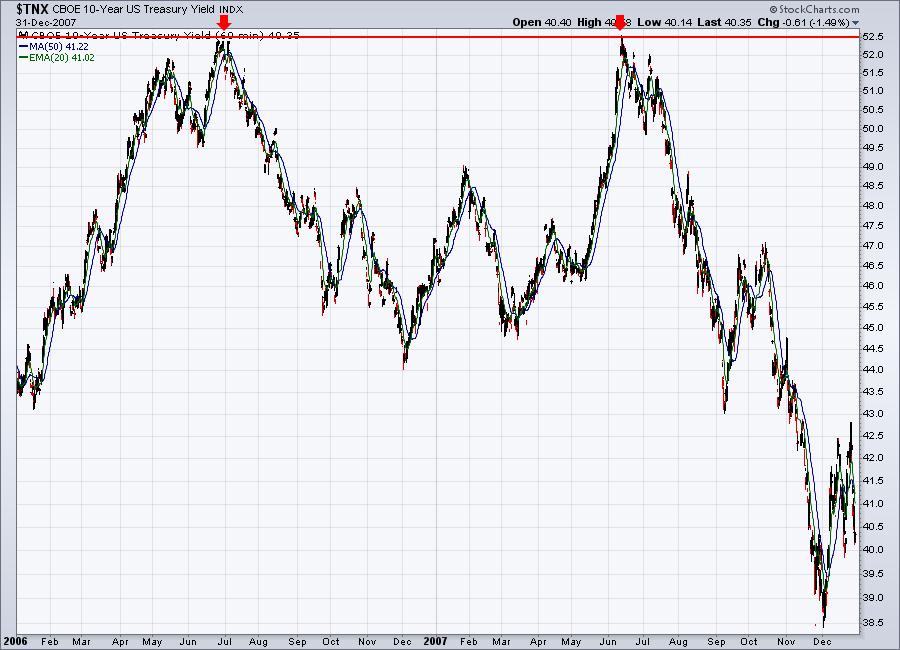
First, the TNX has now reached a level where prior highs in 2007 were ultimately reached:
The highs then were very close to the 5.25% level that we tested yesterday:
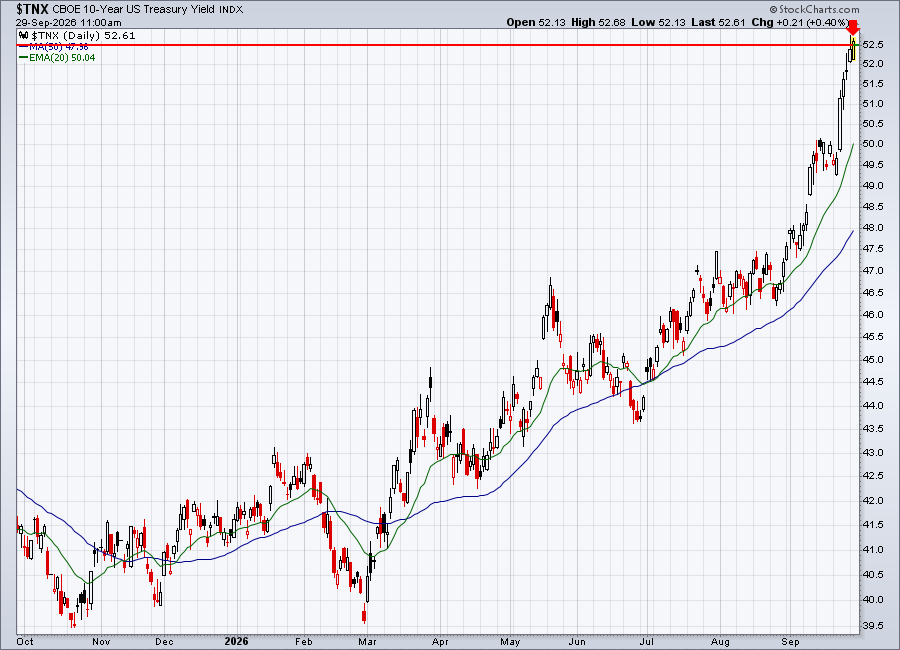
Normally, when you reach a key overhead resistance level like this, traders reverse course and buy treasuries, sending yields back down. If that's the case here, then small caps would quite likely benefit. They've reached oversold territory with an RSI near 30.
TNX Prints 60-Minute Negative Divergence
As the TNX reaches that key short-term resistance level at 5.25%, it's doing so with a negative divergence on its hourly chart:
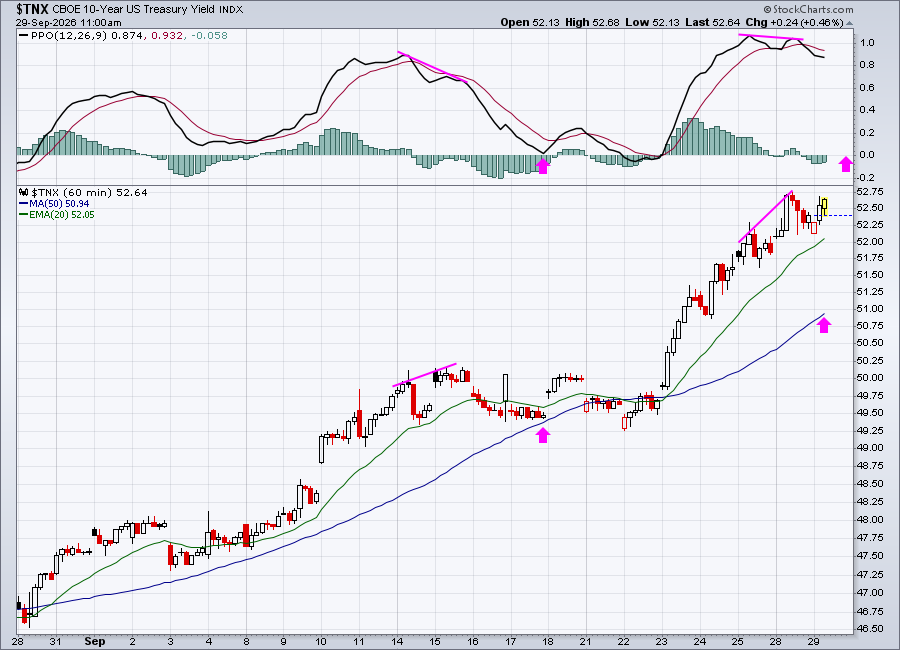
The pink arrows highlight what I look for after a negative divergence prints. I believe the odds increase that we see a PPO centerline test and/or a 50-period SMA test. The last time we saw an hourly negative divergence, back in mid September, we saw both tests. Will we again? It's not a guarantee, but I do think the odds are increasing.
Obvious Inverse Relationship on Chart
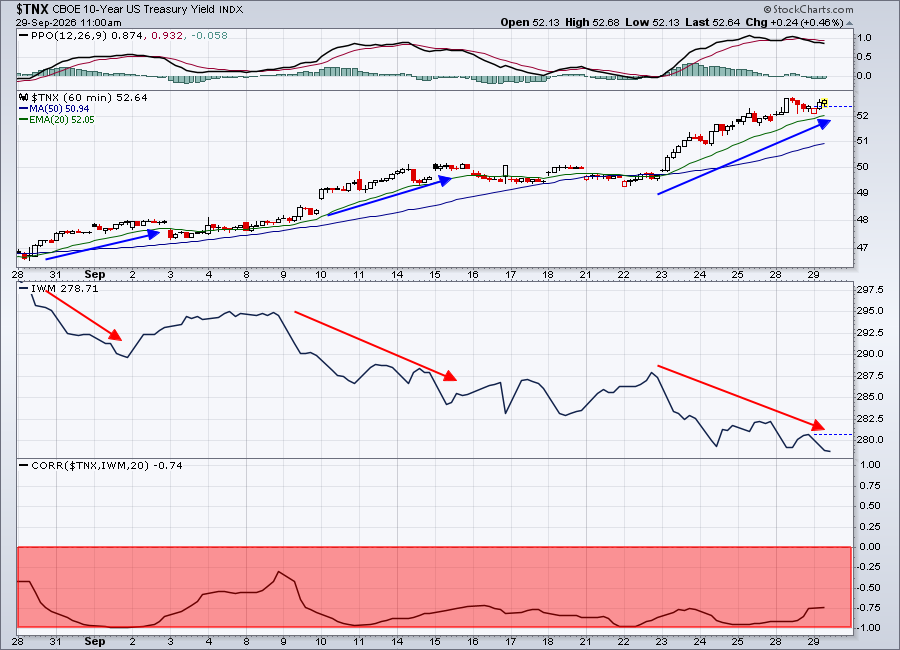
If the negative divergence kicks in and the TNX reverses at key yield resistance at 5.25%, it's a fairly solid bet that money will rotate back into small caps during any TNX decline. Check out this relationship over the past 6 weeks:
Personally, I've been sitting mostly in cash in my trading account in September, waiting for an opportunity. While this one certainly is no guarantee, I do like the way it's setting up. So, for me, it's just a matter of setting reasonable stops. I don't want to set them too tight, but I also do not want to endure a large loss. I've chosen to purchase the leveraged TNA (tracks the IWM and moves at a 3 to 1 clip) in increments, both at current price and at slightly lower levels, if we do see continuing pressure in small caps.
My Strategy
I buy the leveraged TNA product based on key support levels on the IWM. I DO NOT USE THE TNA CHART TO LOOK FOR SUPPORT LEVELS. I see two important support levels on the IWM, the first at 279-280, which is where we are right now. The second one, which is the HUGE support level, is at 269. My target is the recent price high near 305. I want to establish a position now in the TNA, which I've done (roughly one-fifth, or 20%, of my intended position). I will buy my next 20% if the IWM reaches 274-275 and my final 60% in 20% increments as the IWM hits moves down from 274 to 269. I will close out the TNA if the IWM closes beneath 265.
If this trade blows up, I'll probably lose about 10%. So if my total cost is $10,000, I'd lose $1,000. If my total cost is $100,000, I'd lose $10,000. In order to keep the losses lower, a different strategy would be to buy the TNA now and sell it quickly if the IWM closes below 279. The thinking here is that you can always jump back in later if the IWM approaches 269. Risk is a personal choice and I am NOT a Registered Investment Advisor (RIA). I don't know each member's risk tolerance, so considering this trade and how much money you're willing to lose, is a personal choice for each of you.
The upside is significant. Should the IWM eventually move back to 305 and all of my buys trigger, I'd be looking at a 10% gain in the IWM, or 30% in the TNA. So the strategy I laid out gives me room to the downside on the IWM, but ultimately provides me a 3 to 1 reward-to-risk ratio. That reward to risk relationship can change depending on how much downside risk you're comfortable with. Like I said, entering now and exiting on any IWM close beneath 279 establishes a much, much better reward-to-risk ratio. But the odds of being whipsawed and taken out of the position prematurely are greatly enhanced as well.
I believe the TNX is pricing in two more rate hikes. I also believe traders in interest-rate-sensitive areas are overreacting, creating an opportunity in Q4. If I'm wrong, I'll lick my wounds and move on.
Happy trading!
Tom